The Panama Canal does not need to close for global supply chains to feel the effects of El Niño.
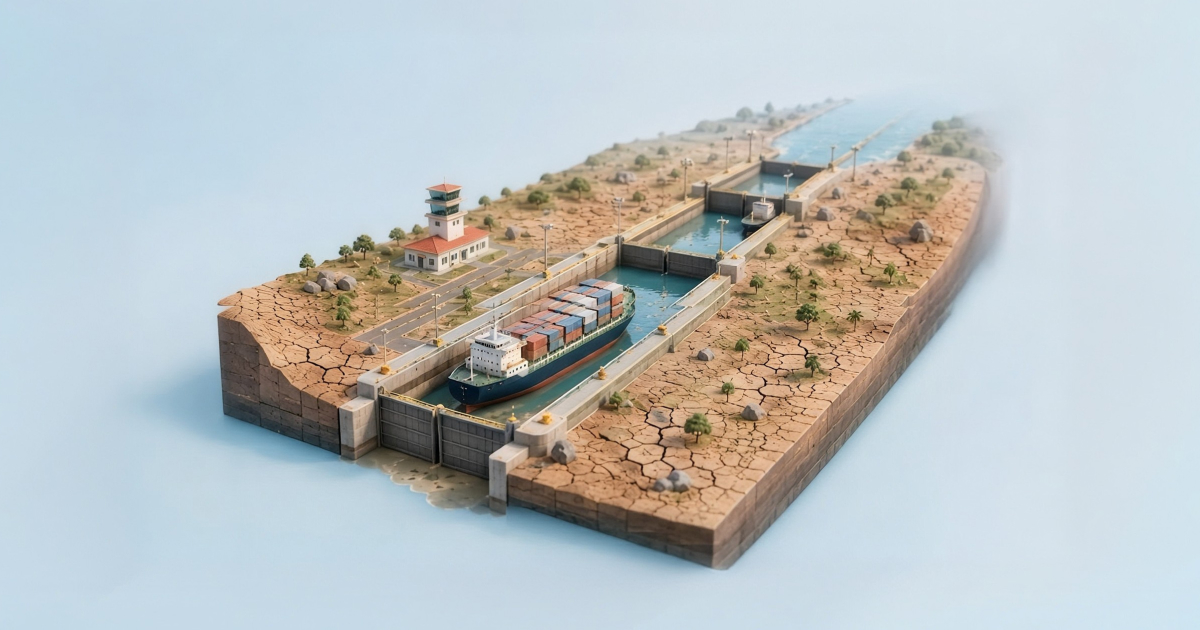
The latest constraints at the Canal may look like a shipping problem, but the story begins far upstream from the vessels passing through it. Rainfall across the Canal watershed has fallen below expectations even during Panama’s rainy season, with El Niño contributing to conditions that are putting additional pressure on the lake system supporting Canal operations. Because every transit depends on freshwater, changes in the watershed can eventually determine how deeply vessels can be loaded and how many ships the Canal can accommodate each day.
Ships are still moving through the Panama Canal, but an El Niño-driven rainfall deficit is beginning to change how much traffic the waterway can handle. Beginning September 3, 2026, daily Neopanamax slots will fall to nine and Panamax slots to 25, with Panamax availability scheduled to decline again to 23 slots per day on September 15. The Panama Canal Authority has cited below-expected precipitation and the adverse effects of El Niño as reasons for the temporary changes.
What makes the situation important for supply chain leaders is not simply the reduction in transit capacity. Panama illustrates how an environmental condition can gradually become an infrastructure constraint and work its way into transportation networks, costs and production schedules. There may never be a single moment when the Canal suddenly becomes “disrupted.” Capacity can tighten over time while ships continue moving and the infrastructure remains operational.
By the time that pressure appears as a significant shipment delay or material shortage, the conditions behind it may have been developing for months. That makes Panama a useful test case for a much broader question: How much of your supply chain depends on infrastructure whose capacity can change because of environmental conditions you may not be monitoring?
El Niño is putting a familiar vulnerability back in the spotlight
El Niño is a recurring climate pattern associated with changes in ocean temperatures and atmospheric circulation across the tropical Pacific, with effects that vary considerably by geography. For Panama, periods of lower rainfall can become especially consequential because the Canal is fundamentally dependent on freshwater.
Unlike many of the world’s major maritime chokepoints, the Panama Canal relies on a lake and lock system that uses freshwater as vessels transit. The watershed also supports other water needs within Panama, meaning an extended rainfall deficit creates a resource-management challenge that reaches beyond maritime traffic. The amount of cargo moving through one of the world’s most important trade corridors is therefore connected, quite literally, to how much rain falls across the surrounding watershed.
The consequences of that relationship became particularly visible during the severe drought of 2023 and early 2024. As water levels declined, the Canal Authority reduced transits and imposed operating restrictions, while some vessels shifted to longer routes. By early 2024, UN Trade and Development reported that total Canal transits had fallen 49% from their previous peak, with the disruption contributing to higher transportation costs.
Conditions subsequently improved, but the underlying dependency remained. That history makes the return of El Niño-related rainfall pressure worth watching without assuming that 2026 will reproduce the severity of the previous drought. What matters is that the relationship between rainfall, water availability and Canal capacity is once again influencing operating decisions, giving companies an opportunity to follow the progression before it reaches their own operations.
The disruption begins before the bottleneck
Drought is particularly challenging because it develops differently from the sudden events supply chain teams are accustomed to managing. Water stress accumulates over time, moving through connected systems until an environmental issue eventually becomes a commercial one.
At the Panama Canal, declining precipitation can affect reservoir conditions, leading operators to tighten vessel drafts or reduce transit availability. Shipping lines then have to determine how much cargo they can carry and whether existing schedules still make economic sense. Eventually, those decisions reach companies through higher freight costs, longer lead times and greater uncertainty around inventory.
The financial impact can arrive before severe congestion does. During the previous Panama Canal drought, UNCTAD found that disruption at the Canal contributed substantially to increases in the Baltic Dry Index between October 2023 and January 2024. Longer routes also increased sailing distances and placed additional pressure on vessel capacity.
Rerouting can provide relief, although recent maritime disruptions demonstrate how quickly it can transfer pressure elsewhere. When vessels shift to longer routes, more shipping capacity is required to move the same volume of goods, while alternative ports and transportation networks may experience additional demand. During the broader maritime disruptions of 2023 and 2024, UNCTAD estimated that rerouting away from the Red Sea and Panama Canal increased global vessel demand by 3% and container ship demand by 12% by mid-2024.
For companies watching Panama today, the response is therefore more nuanced than deciding whether to stay with the Canal or go around it. A longer route might make sense for a production-critical component with limited inventory and no readily available substitute, while the added cost may be difficult to justify for a shipment that can tolerate more time in transit.
The chokepoint tells you where pressure is building. Your supply chain tells you how much that pressure matters.
The same Canal restriction can create very different business outcomes
Imagine two manufacturers whose suppliers both depend on the Panama Canal. One has multiple qualified sources and enough inventory to absorb additional transit time. The other relies on a specialized component from a single supplier, with little inventory available and a lengthy process for qualifying an alternative.
Both companies are exposed to the same Canal conditions, yet their potential business consequences are dramatically different.
That is why useful disruption intelligence has to go beyond knowing that something is happening. Supply chain teams need to understand where the event intersects with their own suppliers, sites and parts, including dependencies several tiers below the companies they buy from directly.
This is where Resilinc’s agentic intelligence platform can connect emerging disruption signals with supplier, site and part-level exposure across the supply network. That context helps teams identify which dependencies could become vulnerable as conditions evolve and where the potential business impact is concentrated.
With a slow-moving risk such as drought, making that connection early is particularly valuable. A rainfall deficit becomes considerably more important when declining water availability begins constraining a transportation corridor used by a single-source component supporting a critical product. Understanding that exposure allows teams to concentrate their attention where additional lead time or transportation costs could actually threaten operations.
Early warning is only useful when it leads to a decision
The Panama situation challenges the conventional idea of what constitutes an early supply chain warning. If the first alert arrives when a vessel is delayed, much of the story has already happened.
The earlier signals can appear in changing precipitation and reservoir conditions, followed by draft restrictions and reductions in transit availability. Carrier pricing or routing decisions may then indicate that infrastructure pressure is beginning to influence commercial behavior.
Individually, those developments may not warrant intervention. Their value comes from understanding how they are progressing and whether they intersect with parts of the supply network that matter to the business.
This is also why simply adding more weather data does little to improve resilience. Supply chain teams already contend with an enormous amount of external information. What they need is context that helps distinguish an interesting development from one that could materially affect production.
For Panama, that means moving from “El Niño is affecting rainfall” to a much more useful question: What happens to our supply chain if Canal conditions continue to tighten?
Plan for several outcomes while options are still available
There is no certainty about how rainfall and Canal conditions will evolve in the coming months, and effective resilience planning does not require one. Companies can instead evaluate how their operations would respond under different levels of constraint.
A modest reduction in transit capacity may introduce manageable schedule variability, while deeper draft restrictions could change cargo economics. Persistent water stress may eventually make alternate routes or sourcing decisions more attractive, particularly for critical components.
Resilinc’s Disruption Agent supports disruption simulation and revenue-at-risk analysis, while SC Command can support deeper enterprise what-if scenarios and AI-generated action plans. The objective is to understand what different levels of Canal constraint would mean for the organization’s own suppliers and operations before a particular response becomes unavoidable.
This approach also brings greater discipline to decisions about rerouting. An expensive transportation alternative may make sense for a specialized component capable of stopping production, while a shipment protected by several weeks of inventory may not require the same response. The same principle applies to alternate sourcing.
Making those decisions earlier preserves flexibility. Once many companies begin competing simultaneously for transportation capacity, inventory or qualified suppliers, the available options can become more limited and expensive.
Panama is exposing a larger infrastructure blind spot
The Panama Canal is an unusually visible example of a dependency that exists throughout global supply chains. Companies may know exactly which supplier produces a critical component while having far less visibility into the infrastructure that allows that supplier to operate and deliver it.
Panama makes that hidden dependency easy to see. The initial pressure comes from environmental conditions in a watershed, which influence the operating capacity of transportation infrastructure. Commercial decisions follow, and the effects can eventually reach manufacturers and customers thousands of miles away.
Other dependencies may be less obvious, but the principle is the same. A supplier’s ability to perform can depend on infrastructure and resources outside the four walls of its facility. Understanding those relationships is becoming an increasingly important part of supply chain resilience.
The broader maritime system can also amplify disruption when traffic shifts from one constrained corridor to another. UNCTAD has warned that pressure on major global chokepoints can expose vulnerabilities throughout international supply chains as vessels and capacity are redirected elsewhere.
For supply chain leaders, visibility increasingly needs to extend beyond knowing who supplies a part. It also means understanding the conditions that could prevent that supplier from producing or delivering it.
Heed the warning while there is still time to act
The most useful aspect of the Panama Canal’s current situation may be that it remains a developing constraint rather than a full-scale shipping crisis. Vessels continue to transit the Canal while the Canal Authority adjusts capacity and manages water availability in response to watershed conditions.
That gives companies time to determine what deeper constraints would mean for their own operations.
El Niño may continue to put pressure on rainfall and Canal capacity, or conditions may improve. Supply chain teams do not need to predict the outcome perfectly. They need to know where their exposure sits and which decisions would become necessary if conditions deteriorate.
The larger lesson from Panama is that supply chain disruption can begin long before a supplier misses a delivery. Here, the warning begins with rainfall and gradually moves through infrastructure until it reaches the commercial supply chain.
The Panama Canal may be the immediate warning. The bigger issue is whether companies can see the environmental and infrastructure dependencies hidden throughout their own supply chains before those dependencies become disruptions.