
Think your supply chain is diversified? Hidden dependencies beyond Tier-1 suppliers can create unexpected disruptions.
Most organizations know who they buy from. The harder question is whether they know who their suppliers depend on. That distinction is becoming increasingly important as disruptions originate further upstream. A factory fire affecting a contract manufacturer, export controls on a critical material, or severe weather disrupting a major manufacturing region can all impact production long before a Tier-1 supplier reports a delay. Without visibility beyond direct suppliers, organizations often don’t recognize they are exposed until lead times increase, inventory tightens, or production schedules begin to slip.
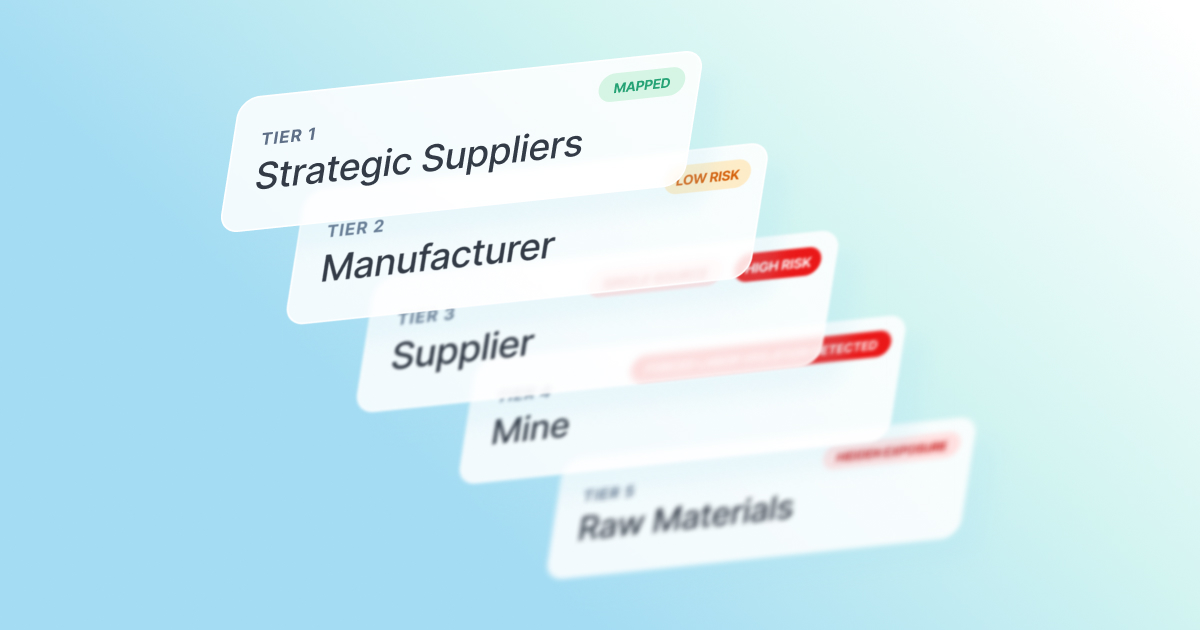
This visibility gap is common across global supply chains. Recent industry research shows that while most organizations have visibility into their Tier-1 suppliers, far fewer can trace supplier relationships beyond the second tier. Yet many of today’s largest disruptions begin deeper within the supply network, where manufacturers, processors, logistics providers, and raw material suppliers support multiple customers simultaneously.
Looking beyond Tier-1 suppliers reveals risks that traditional supplier management often misses. Understanding where those dependencies exist helps organizations assess exposure earlier, prioritize supplier engagement, and respond more quickly when disruptions occur. Here are four hidden risks that frequently exist beyond Tier-1 suppliers.
1. Hidden supplier concentration
How can multiple suppliers create the same risk as a single supplier?
It happens more often than many companies realize.
Sourcing the same component from multiple Tier-1 suppliers is a common strategy for reducing disruption risk. Those suppliers may appear independent while relying on the same Tier-2 manufacturer, specialty processor, or production facility several tiers upstream. When that shared supplier experiences a disruption, every downstream supplier connected to it can be affected.
This concentration is difficult to identify because procurement decisions are typically made one supplier at a time. Relationships beyond direct suppliers rarely appear in purchase orders, supplier scorecards, or contract data. McKinsey’s 2025 Supply Chain Risk Pulse found that 95% of organizations have visibility into Tier-1 suppliers, but only 42% have visibility into Tier-2 suppliers or beyond. As companies adapt to tariffs, export controls, and shifting manufacturing footprints, understanding supplier networks beyond Tier 1 has become increasingly important.
The rapid expansion of AI infrastructure illustrates the challenge. Global investment in semiconductor manufacturing continues to grow, yet advanced packaging, specialty substrates, and certain wafer fabrication processes remain concentrated among a relatively small number of suppliers and facilities. A manufacturer may purchase components from several Tier-1 suppliers while unknowingly depending on the same upstream production bottleneck.
Autonomous mapping reveals supplier relationships across multiple tiers, helping companies identify shared upstream dependencies before they become single points of failure.
2. Hidden material dependencies
Do you know where the materials inside your products are processed before they reach your suppliers?
For many companies, the answer is no. Procurement teams often know who manufactures a finished component. Tracing the materials inside that component through mining, refining, chemical processing, and intermediate manufacturing is considerably more difficult. Those upstream stages often involve suppliers and manufacturing networks that remain invisible when managing finished components.
“The product challenge is not just expanding the map deeper. It is knowing which deep-tier paths are relevant to a customer’s parts and materials. With Tier-N expansion and Rare Earth Lens (and Conflict Minerals, Critical Minerals lenses) we are filtering the network around the exposures that matter instead of asking users to interpret every possible upstream connection.”
– Sachin Gadre, Director of Product Management, Resilinc
Connecting products to the materials they contain provides valuable context when evaluating supplier exposure, responding to export controls, or assessing disruptions affecting critical manufacturing inputs. Material intelligence helps companies understand not only who supplies their products, but also which processing networks those products ultimately depend on.
3. Hidden geographic concentration
Can a disruption affect multiple suppliers at the same time, even if they operate as separate businesses?
Yes. It often happens because suppliers share the same manufacturing ecosystem. Supplier locations tell only part of the story. Multiple suppliers may manufacture products within the same industrial region, depend on the same port, source power from the same electrical grid, or rely on the same transportation corridor. A disruption affecting that shared infrastructure can interrupt production across numerous suppliers simultaneously.
This pattern is common in highly specialized industries. Semiconductor production is concentrated in a relatively small number of regions with advanced fabrication facilities. As AI demand increases pressure across the semiconductor supply chain, that concentration is becoming more visible beyond the fab itself.
“AI demand has made this concentration more visible across the semiconductor supply chain. Capacity constraints are showing up not only in fabs, but also in advanced packaging and memory. The ecosystem is beyond strained at this point. This is no longer just a one-supplier or one-region risk. There are significant chokepoints across the whole process, from foundry capacity and packaging suppliers to equipment suppliers, materials, and chemicals. These are increasingly category-level risks, not just one-off supplier disruptions.”
— Rick Freeman, Semiconductor and High Tech Industry Expert, Resilinc
Automotive manufacturing clusters around established supplier networks. Critical minerals pass through the same refining and processing hubs before reaching manufacturers. These ecosystems improve efficiency while creating shared exposure when severe weather, infrastructure failures, or geopolitical events disrupt the region.
The UK Government’s 2026 Global Supply Chains: A Foresight Report on Risk and Resilience highlights this challenge, explaining that disruption spreads through shared suppliers, regions, infrastructure, and transport routes. Evaluating direct supplier relationships alone does not reveal the network dependencies that allow disruption to cascade across industries.
Part-site visibility adds another layer of understanding by connecting products to the locations where they are manufactured. That context helps companies identify when multiple suppliers ultimately depend on the same region, supporting better sourcing decisions and business continuity planning before a regional event develops into a broader supply chain disruption.
4. Hidden disruption signals
When does a disruption actually begin?
For many companies, the answer is when a supplier reports a delay. In reality, the disruption often started days or weeks earlier.
A factory fire, labor dispute, cyberattack, export restriction, or severe weather event rarely affects only one company. It begins at a supplier site, manufacturing facility, logistics hub, or critical transportation route before gradually moving through the supply network. By the time production schedules change or shipments are delayed, the disruption has already spread beyond its point of origin.
Recent events demonstrate how quickly these disruptions can cascade across industries. Export controls on critical materials have affected manufacturers far beyond the countries where the policies were introduced. Disruptions in the Strait of Hormuz created uncertainty across energy, petrochemical, and transportation networks, affecting companies with no direct operations in the region. In each case, the operational impact emerged well after the initial event.
The OECD’s 2026 Responsible Business Outlook reached a similar conclusion, noting that disruption risk increases with each upstream tier of the supply chain and that limiting due diligence to Tier-1 suppliers leaves companies exposed to operational risks that exist deeper within supplier networks.
Recognizing these events early requires more than monitoring global headlines. Supply chain teams need to understand whether a disruption is connected to their suppliers, which products may be affected, and where exposure exists before delays begin. AI-powered disruption monitoring strengthens that awareness by connecting real-time events to mapped supplier networks, allowing teams to focus on the disruptions that matter most to their business.
Looking beyond Tier-1 suppliers
Supply chain disruptions rarely follow organizational boundaries. They move through supplier networks, manufacturing sites, transportation infrastructure, and material supply chains before affecting finished products. Companies that focus only on direct suppliers often discover these connections after a disruption has already affected operations.
The four risks explored in this article share a common characteristic: they are difficult to identify through traditional supplier management alone. Shared upstream suppliers, concentrated material processing, regional manufacturing ecosystems, and emerging disruptions all exist beyond the visibility of most procurement systems. Understanding those connections provides valuable context for sourcing decisions, supplier engagement, business continuity planning, and disruption response.
Those capabilities are the focus of Resilinc’s upcoming webinar, You Can’t Manage the Supply Chain Risks You Can’t See.
During the session, our experts will demonstrate how Autonomous Mapping, multi-tier supplier intelligence, part-site visibility, and EventWatchAI work together to uncover hidden supplier dependencies, identify geographic concentration, and improve real-time awareness across complex global supply chains. You’ll also see how mapping products through Tier-N suppliers reveals upstream connections that are often impossible to identify through traditional supplier records alone.
If your team is working to strengthen supply chain resilience or improve its understanding of upstream risk, this webinar will provide practical insights into how leading organizations are building greater awareness across their supply networks.
Register today and learn how greater visibility beyond Tier-1 suppliers can help identify hidden risks before they become business disruptions.