
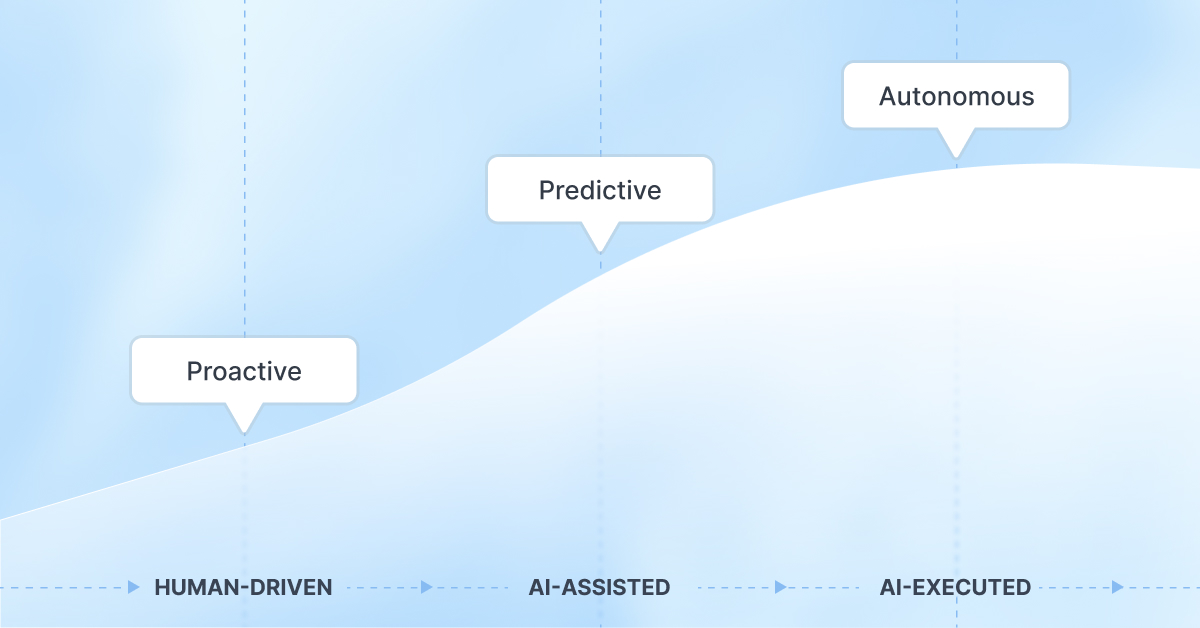

The next stage of supply chain maturity starts with agentic AI.
For years, supply chain leaders have measured progress through maturity models that help organizations evolve from responding to disruptions after they occur to proactively managing risk and ultimately building resilient operations. But as disruption frequency, complexity, and velocity continue to increase, resilience alone is no longer enough.
That was the central theme of a recent SupplyChainBrain webinar, A Modern Approach to Supply Chain Maturity in an Era of Disruption, featuring Gop Rao, Chief Marketing Officer at Resilinc, alongside former Chevron executive Diego Guerrero. Together, they explored how organizations can move beyond traditional supply chain risk management and embrace a new stage of maturity powered by agentic AI.
Why does the supply chain maturity model need to evolve?
For decades, supply chain maturity has been viewed as a progression from manual disruption response to monitoring, integrated processes, and ultimately resilience. Today, the pace and complexity of disruption are redefining what maturity looks like and agentic AI is becoming the next stage of that evolution.
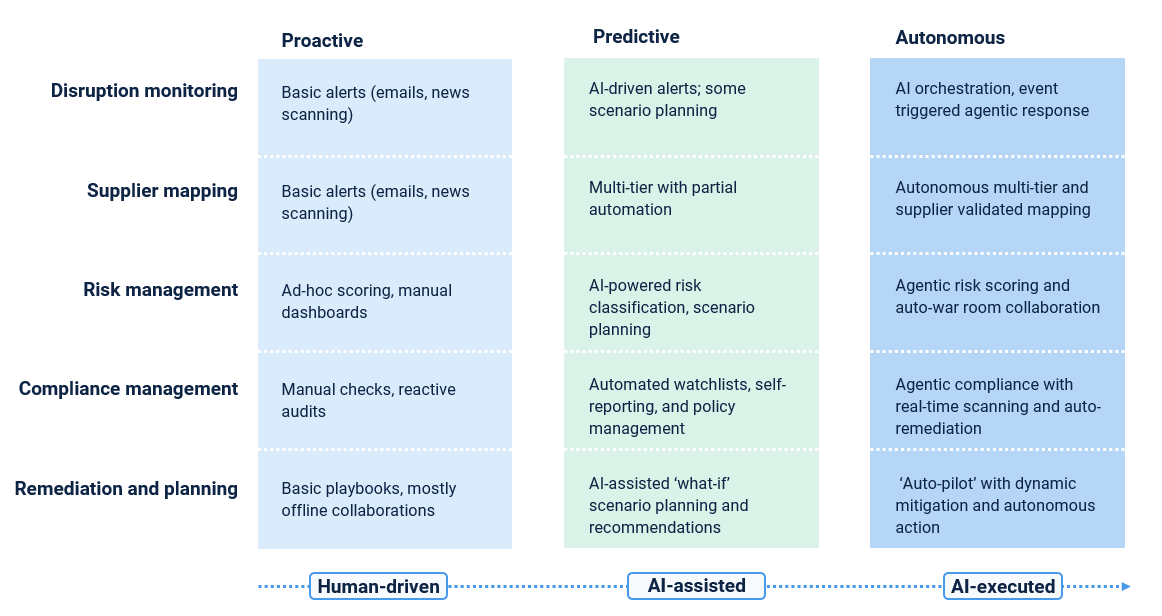
Geopolitical instability, labor shortages, cyberattacks, tariffs, regulatory changes, and extreme weather events are no longer isolated incidents. They overlap, accelerate, and compound one another, making it increasingly difficult for organizations to understand not only that a disruption has occurred, but more importantly, how it will affect their business.
“Maturity means operating across tiers, across systems, and across functions. That’s both a capability shift and a skill shift as AI increasingly enters the domain.”
— Gop Rao, Chief Marketing Officer, Resilinc
The discussion highlighted three persistent challenges that continue to limit even mature organizations:
- Limited visibility beyond tier-one suppliers
- Data spread across disconnected systems
- Organizational silos that slow decision-making
As disruptions continue to increase across nearly every category, the next stage of maturity requires more than visibility; it requires the ability to continuously sense, analyze, recommend, and act with speed and confidence.
How multi-tier visibility improves supply chain risk management
One of the strongest themes throughout the webinar was the importance of multi-tier visibility.
Most organizations have a good understanding of their tier-one suppliers. But risk rarely stops there. Hidden dependencies often exist several layers deeper within the supply chain, where a single supplier can support multiple products, customers, or billions of dollars in revenue.
Autonomous mapping combined with supplier validated mapping provides organizations with faster visibility into those sub-tier relationships, uncovering hidden dependencies before they become costly disruptions.
The discussion also highlighted an important reality: supplier criticality isn’t always reflected in annual spend. A relatively small supplier may ultimately support a mission-critical product or production line. Without visibility into these upstream relationships, organizations often don’t recognize the risk until production is already impacted.
The takeaway is clear: meaningful resilience starts with understanding the full supply network.
AI is only as good as the data behind it
While much of the conversation centered on AI, the panel repeatedly emphasized that data remains the true foundation of supply chain maturity.
“Data shouldn’t be an afterthought. It should be treated as an asset.”
— Diego Guerrero, former Global Head of Data & Insights, Procurement and Supply Chain Management, Chevron
Three elements stood out as essential:
- Availability – Organizations need integrated, standardized data across procurement, planning, logistics, and supplier systems. Many companies believe they are data-rich because they operate an ERP, but fragmented supplier records, duplicate data, and disconnected systems often create blind spots.
- Context – Data becomes valuable only when it’s connected to business priorities. Understanding which suppliers, parts, or materials are truly critical allows organizations to distinguish between routine events and disruptions that could materially impact operations or revenue.
- Trust – Without confidence in the data, organizations struggle to trust AI-generated recommendations. Strong governance, transparency, and data quality are essential for enabling faster, more confident decision-making.
The shift from monitoring to intelligent action
Traditional supply chain tools excel at collecting information and sending alerts.
The next generation of supply chain technology goes further.
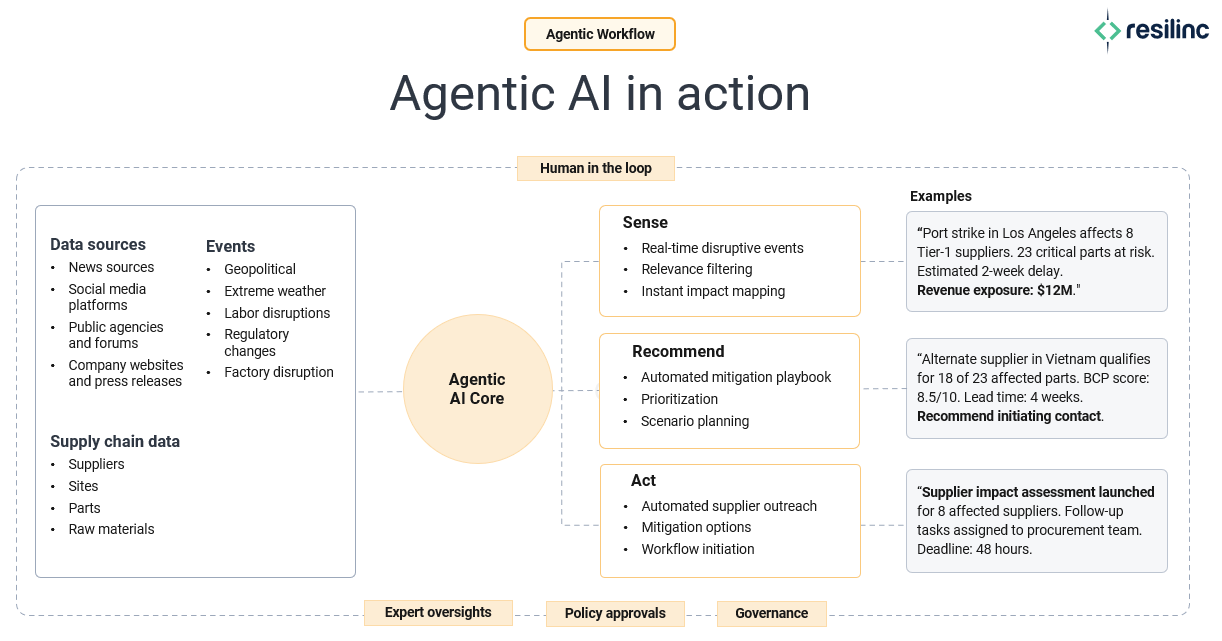
Rather than simply notifying teams that an event has occurred, agentic AI continuously connects supplier data, material flows, logistics information, regulatory updates, and real-time events to answer the questions executives immediately ask during a disruption:
- Which suppliers are affected?
- Which parts and products are exposed?
- What revenue is at risk?
- What alternatives are available?
- What actions should we take next?
Instead of waiting for multiple teams to gather information independently, AI can help prioritize risks, recommend mitigation strategies, initiate workflows, and keep response efforts moving, all while operating within defined business policies and human oversight.
The result is a supply chain that continuously learns, improving recommendations and strengthening resilience over time.
Why AI governance matters for supply chain risk management
One of the most common questions during the webinar centered on trust: How can organizations confidently allow AI to make decisions?
The answer wasn’t “more automation.” It was better governance.
Successful organizations establish clear guardrails before introducing autonomous capabilities, including:
- Defined approval thresholds
- Governance frameworks
- Business KPIs
- Human oversight for high-impact decisions
- Continuous feedback loops that improve AI performance over time
The panel emphasized that the journey toward autonomous decision-making is incremental. Organizations should begin by allowing AI to support analysis and recommendations before gradually expanding into execution within clearly defined policies. This approach builds trust while maintaining accountability.
Looking ahead to a new era of supply chain maturity
The next generation of the supply chain maturity model isn’t simply about becoming more resilient. It’s about becoming more intelligent.
Organizations that combine trusted data, multi-tier visibility, AI-powered insights, and well-governed automation will be better equipped to navigate continuous disruption, respond with greater speed, and make more informed decisions across increasingly complex global supply chains.