Risk, compliance, and sustainability depend on the same capability
In Food and Beverage, companies usually talk about risk, compliance, and sustainability as if they are separate initiatives. One team is focused on continuity of supply. Another is dealing with regulatory pressure and documentation. Another is trying to hit ESG or responsible sourcing goals. On paper, those can look like different workstreams. In practice, they all depend on the same capability.
The real issue is upstream visibility
The real issue is whether a company can trace deeply enough into its upstream supply chain to understand where ingredients, raw materials, and packaging are coming from, what risks sit inside that network, and what evidence exists to support decisions when something changes. If that visibility is weak, the business ends up reacting to problems one at a time. A disruption hits. A supplier misses a requirement. A commodity is flagged. A region faces water stress. A customer asks for proof. Then everybody scrambles in parallel with different spreadsheets, different assumptions, and different definitions of what “good” looks like.
That model does not hold up very well anymore.
Why food and beverage is uniquely exposed
Food and Beverage sits in a uniquely exposed position because its upstream supply chain is broad, fragmented, and highly dependent on agricultural inputs, contract manufacturers, co-packers, packaging suppliers, logistics providers, and region-specific sourcing conditions. One issue rarely stays contained. A climate event is a supply risk, but it is also a cost issue, a sustainability issue, and sometimes a customer commitment issue. Packaging sourced from the wrong place is not just a procurement problem. It can quickly become a traceability problem, a compliance problem, and a brand problem. A commodity linked to deforestation, water stress, or labor concerns may begin as an ESG discussion, but it does not stay there for long.
How EUDR raises the bar on supply chain evidence
That is especially true as regulations like EUDR begin forcing a much higher standard of upstream visibility and evidence. For many Food and Beverage companies, particularly those sourcing commodities like cocoa, coffee, palm oil, soy, cattle-related inputs, rubber, or wood-based packaging, EUDR is not just another reporting requirement. It raises the bar on whether a company can actually trace relevant materials back through the supply chain, understand where exposure exists, and support its due diligence position with something more substantial than supplier self-attestation. Viewed that way, EUDR is not simply a compliance exercise. It becomes a broader test of supply chain maturity.
Why water stress connects risk and sustainability
Water stress provides another example of where risk, sustainability, and operational planning converge. In Food and Beverage, water is not an abstract ESG topic. It directly affects ingredient availability, agricultural yield, manufacturing continuity, community impact, and long-term sourcing strategy. Two facilities may have the same internal reduction target, but the business risk and sustainability impact can look very different depending on whether they operate in a water-rich region or a highly stressed basin. That is why local context matters so much. Companies need to understand not only their own footprint, but also the upstream exposure tied to the regions and suppliers they depend on.
The better question: shared understanding, not separate programs
That shifts the conversation. The question is no longer whether companies need a risk program, a compliance program, or a sustainability program. Most do. The better question is whether those programs are operating from the same understanding of the upstream supply chain or whether each is building its own version of supplier reality.
How Resilinc connects the dots
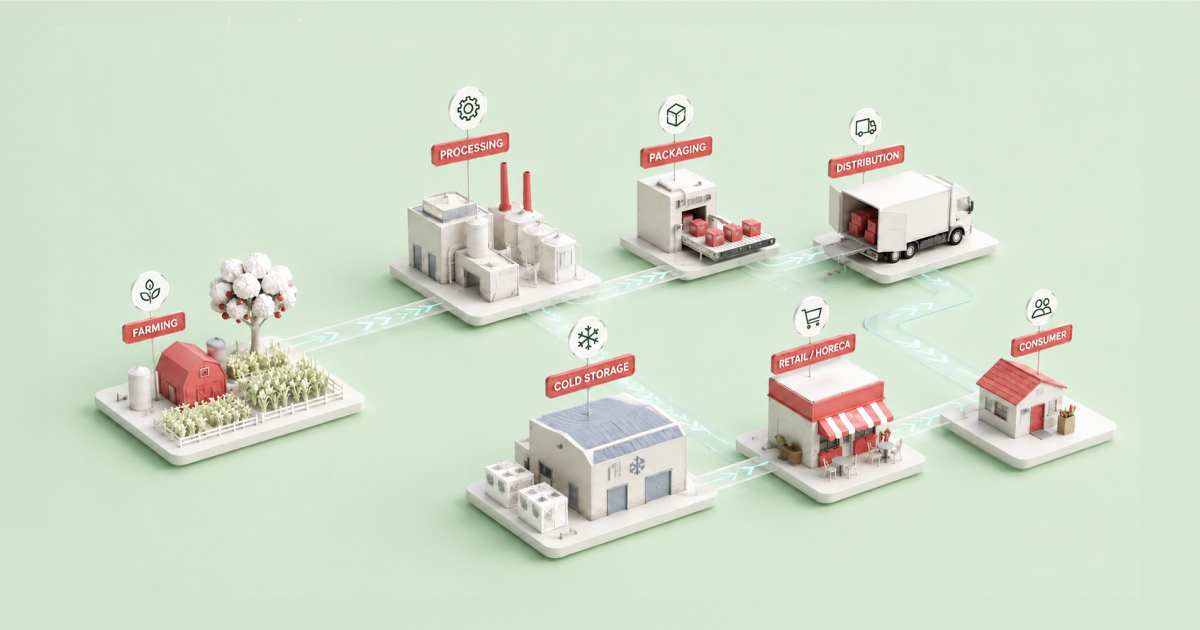
That is where Resilinc can help in a way that is more practical than most people realize. The value is not just in monitoring disruptions or mapping suppliers for the sake of having a map. It is in connecting suppliers, sites, ingredients, materials, products, geographies, and shipments into a usable operating picture of exposure. Once those relationships are established, the same supply chain data can support responsible sourcing, EUDR readiness, supplier due diligence, water risk prioritization, compliance activities, and business continuity without each team recreating the same work from scratch.
Why upstream problems rarely stay upstream
For Food and Beverage companies, that matters because upstream problems rarely remain upstream. A drought, flood, port disruption, geopolitical event, quality issue, or supplier financial problem can quickly become an inventory issue, a service issue, or a cost issue. Detecting an event is only part of the challenge. The business also needs to understand which products, suppliers, facilities, customers, and regions are affected before those impacts spread further through the supply chain. Resilinc helps make those connections visible earlier so teams are not simply aware that something happened but understand what it means for the business.
Why compliance is becoming more operational
At the same time, compliance is becoming much more operational. Whether the pressure comes from customer expectations, retailer requirements, internal governance, or regulations tied to sourcing, deforestation, human rights, or emissions, companies increasingly need to show their work. It is no longer enough to say a supplier is compliant or a sourcing program is responsible. The question becomes what evidence exists, how complete it is, and whether it can be connected back to actual products and supplier relationships. Sustainability is following the same path. It is becoming less about reporting high-level outcomes and more about understanding commodities, regions, water usage, agricultural exposure, packaging inputs, and the sourcing decisions that influence long-term resilience.
What AI can do with structured supply chain data
That same traceability foundation also changes what AI can realistically accomplish. In Food and Beverage, AI is only useful if it can work from structured, connected, validated supply chain data. Otherwise, it just produces more noise, faster. But when those underlying relationships already exist, AI can identify exposure, surface patterns, prioritize what matters, accelerate evidence gathering, and help teams move from detection to action with far less manual work in between.
The bigger opportunity: one foundation, multiple priorities
That is where the conversation becomes more interesting than generic AI messaging. The opportunity is not simply to automate tasks. It is to make the supply chain more responsive and more intelligent across multiple priorities at once. If the same data foundation helps a company understand supplier exposure, commodity risk, EUDR obligations, water stress hotspots, sustainability priorities, and business continuity impacts, the organization stops chasing separate problems and starts operating from a shared understanding of risk and responsibility.
The takeaway for food and beverage leaders
For Food and Beverage leaders, that is probably the bigger unlock. Not another isolated tool or another standalone assessment, but a stronger upstream operating model that gives procurement, supply chain, sustainability, quality, and compliance teams a common foundation from which to work. That is the direction the market is moving, whether companies are organized that way today or not. The organizations that get ahead will not be the ones running risk, compliance, and sustainability in separate silos. They will be the ones that build the visibility, evidence, and operational framework once, then use it across all three.
That is where Resilinc delivers the greatest value. We are not here simply to help companies see more of their supply chains. We are here to help them act on what they see with better evidence, greater confidence, and faster decision-making.
Build traceability once, put it to work everywhere
Resilinc’s SC Monitor creates a connected view of your multi-tier supply chain, linking suppliers, ingredients, commodities, packaging, and products into a single source of truth. Combined with the Forced Labor Compliance Agent, your teams can strengthen EUDR readiness, streamline supplier due diligence, and support responsible sourcing with the evidence needed to demonstrate compliance.