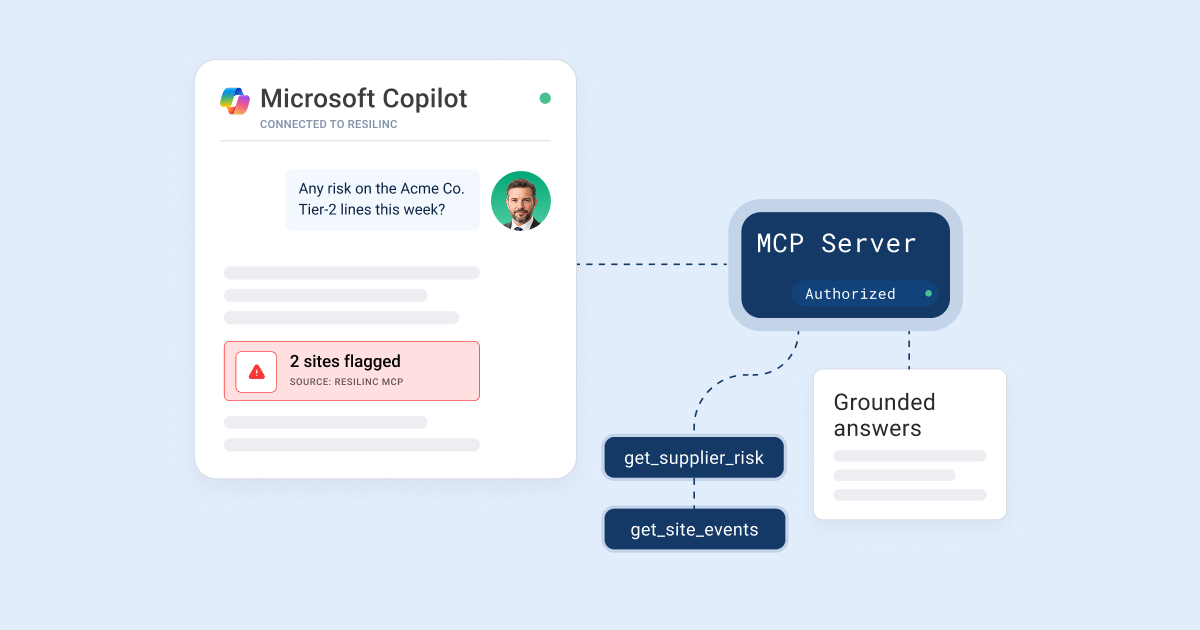
In short: Resilinc’s supply chain risk and compliance intelligence is now available in Microsoft 365 Copilot through a federated connector built on the Model Context Protocol (MCP). Authorized users can ask Copilot plain-language questions, such as which suppliers are exposed to a new tariff, and get answers grounded in their organization’s own suppliers, sites, parts, and materials. Users can only see the Resilinc information they’re already authorized to access.
Supply chain intelligence in the flow of work
Supply chain decisions rarely happen in just one application.
A new tariff is announced. A factory shuts down. A supplier appears on a regulatory watchlist. A sourcing leader needs to know which products could be affected. An executive wants to understand the potential business impact.
Answering those questions requires more than general information. It requires intelligence connected to an organization’s actual suppliers, sites, parts, materials, disruptions, and compliance risks.
That’s why Resilinc’s supply chain risk and compliance intelligence is now available directly within Microsoft 365 Copilot.
How Resilinc works in Microsoft 365 Copilot
Resilinc connects to Microsoft 365 Copilot through a federated connector built on Model Context Protocol (MCP), an open standard that lets AI systems discover and invoke tools exposed by Resilinc’s MCP server. Those tools bring Resilinc’s supply chain risk and compliance intelligence into Copilot, grounded in each customer’s authorized data. Authorized users simply ask their questions in natural language.
This brings Resilinc’s Sense–Recommend–Act approach into the flow of work. Teams can sense emerging supply chain risks, get recommendations grounded in their own supplier, site, and materials data, and identify the actions needed to mitigate potential impact—all through Microsoft 365 Copilot.
Consider a question like: “If new tariffs are announced next week, which of our products could be affected, what revenue might be at risk, and which suppliers and parts should we investigate for alternative sourcing?”
Behind a question like this, Microsoft 365 Copilot calls the relevant tools exposed by Resilinc’s MCP server. Resilinc’s tools analyze tariff exposure by country of origin and supplier, drawing on the customer’s authorized supplier, site, and part data to show where the risk is concentrated. Copilot brings those findings together so the team can see which dependencies need attention and where to investigate alternative sourcing, without leaving the flow of work.
The same approach can extend to questions about supply chain disruptions, forced labor, sanctions, supplier risk, tariffs, and other compliance issues.
Instead of moving between systems, searching for the right report, and assembling information manually, teams can bring relevant Resilinc intelligence into the Microsoft environment where they are already working.
Industry use cases: automotive, life sciences, high tech, and aerospace
Supply chain challenges vary significantly by industry. A disruption affecting an automotive manufacturer may create an entirely different set of decisions for a pharmaceutical company or semiconductor manufacturer.
Connecting Microsoft 365 Copilot with Resilinc brings that industry-specific context closer to the decision.
- Automotive: As manufacturers navigate tariffs, forced labor requirements, critical mineral constraints, and complex multi-tier supplier networks, teams could ask: Which suppliers and parts are potentially exposed to forced labor? Where do we have dependencies on suppliers in the affected region?
- Life sciences: When continuity can directly affect patient care, teams need to quickly understand potential impacts from factory disruptions, regulatory actions, material shortages, and extreme weather. Ask Copilot: Which critical suppliers or materials could be affected by this event? Where do we have potential single-source dependencies?
- High tech and semiconductors: Export controls, geopolitical developments, critical-material restrictions, and highly concentrated manufacturing networks create constantly changing risk. A user might query: Which suppliers or materials in our network could be exposed to this regulatory change? Where do we have dependencies in the affected geography?
- Aerospace and defense: Deep supplier networks make visibility beyond Tier 1 especially important. Procurement and supply chain teams could ask: Which critical suppliers or parts could be affected by Executive Order 14415? Where should we investigate potential sub-tier exposure?
Across industries, the objective is the same: make it easier to connect an external development to the organization’s own supply chain and identify where further investigation or action may be required.
Use cases by role: executives, procurement, operations, compliance, and finance
Supply chain teams don’t just need to know that something happened. They need to understand what it could mean for the business.
A disruption may affect a supplier, but which products depend on that supplier? A tariff may change, but how could it affect landed cost? A compliance issue may emerge deep in the supply chain, but which parts, shipments, or revenue streams require attention?
Here’s how that looks for the people responsible for those decisions:
- Executives can get quickly oriented around enterprise exposure. Instead of asking only What happened?, they can ask: Which of our critical suppliers and products may be affected? Where is our greatest potential revenue exposure? Which risks require immediate attention?
- Procurement and sourcing leaders can investigate the financial implications of supplier and trade developments. For example: Which parts are exposed to the latest tariff change? How could that affect landed cost? Where should we investigate alternative suppliers or sourcing locations?
- Supply chain and operations teams can connect disruptions to operational dependencies. They can ask: Which sites, parts, and products could be affected by this factory shutdown? Which dependencies pose the greatest potential production risk? Where should we prioritize mitigation?
- Compliance teams can investigate regulatory exposure across suppliers and sub-tiers. Questions might include: Which suppliers or materials require further review based on this regulatory change? What products could be connected to that exposure? Where should we prioritize supplier due diligence?
- Finance teams can bring supply chain developments into business-impact discussions earlier. For example: Which supply chain risks could have the greatest financial impact? Where could tariff changes increase costs? Which disruptions may put revenue at risk?
The goal is to make it easier for different stakeholders to connect risk intelligence to the outcomes they are accountable for, from continuity and compliance to cost, revenue, and customer commitments.
Why specialized supply chain data matters for enterprise AI
The value isn’t simply giving Copilot another source of information; it’s connecting enterprise AI to specialized supply chain intelligence.
Resilinc combines more than 16 years of supply chain data and domain expertise with validated, multi-tier relationships across suppliers, sites, parts, products, and materials. Its specialized AI capabilities help organizations monitor disruptions and apply their own supply chain context to understand exposure, evaluate compliance risk, and determine potential next steps.
Through MCP, that intelligence can securely extend into Microsoft 365 Copilot while existing Resilinc authentication, tenant isolation, licensing, and access controls continue to govern what information users can access.
The result is a more connected experience: Microsoft 365 Copilot provides the interface employees increasingly use to ask questions and get work done, while Resilinc provides the specialized supply chain intelligence behind those questions.
Put intelligence closer to the decision
For Resilinc, this work represents a broader vision for enterprise AI.
Supply chain intelligence becomes more valuable when it can travel to the people and workflows where decisions are being made. By making Resilinc intelligence accessible through Microsoft 365 Copilot, we’re helping organizations move from asking What happened? to quickly understanding Does it affect us? What could the business impact be? And where should we look next?
That’s Resilinc’s Sense–Recommend–Act approach brought into the flow of work: connecting real-time developments to supply chain-specific intelligence, recommending next steps, and driving faster, more informed action.
That’s an important step toward a future where supply chain resilience simply becomes part of how the enterprise works.
Already a Resilinc customer or want to learn more? Contact us to explore the benefits of Resilinc with Microsoft 365 Copilot.
Frequently asked questions
What is the Resilinc connector for Microsoft 365 Copilot?
It is a federated Microsoft 365 Copilot connector that gives authorized users access to Resilinc’s supply chain risk and compliance intelligence by asking questions in Copilot, without switching to another application.
How does it work?
The connector uses the Model Context Protocol (MCP). When a user asks a supply chain question, Copilot draws on Resilinc’s multi-tier data on suppliers, sites, parts, products, and materials to answer it in the context of that organization’s own supply chain.
Is my data secure?
Yes. Existing Resilinc authentication, tenant isolation, licensing, and access controls continue to govern what information each user can access.
What kinds of questions can I ask?
Questions about supply chain disruptions, tariffs, forced labor, supplier risk, and other compliance issues. For example: Which of our suppliers could be affected by the latest tariff changes?