
- Industrial technology case study
Belden turns $1B+ supplier spend into revenue-aware sourcing intelligence

Introduction
Belden is a Fortune 1000 industrial technology company serving customers in industrial automation, broadband, smart buildings, and enterprise markets worldwide. Behind that global footprint sits a deeply layered supplier network: 16 independently operating business entities, roughly 1,700 Tier-1 suppliers, and more than $1B in annual spend across categories where component, material, and sub-tier dependencies run several layers deep.
For Shakeel Ahmed, Procurement Excellence Lead at Belden, building resilience across that network meant going beyond reactive risk management. The answer became Supplier Decision Intelligence: a Resilinc-powered framework that shows commodity managers where every supplier and category sits in the portfolio. By mapping supplier, site, part, component, and material relationships across tiers, and connecting those relationships to spend, revenue exposure, risk, resiliency, and sourcing concentration, Belden replaced fragmented signals with fact-based category strategy.
Challenges faced
Before Belden could operationalize that model, it needed a much deeper view of its network. Tier-1 visibility was largely known; what sat beneath it was not. A low-spend supplier could quietly support a critical part. A component could depend on a sub-tier site several layers removed from Belden’s direct supplier relationship. A Tier 3 or Tier 4 dependency could create significant revenue exposure that was effectively invisible from a Tier-1 view.
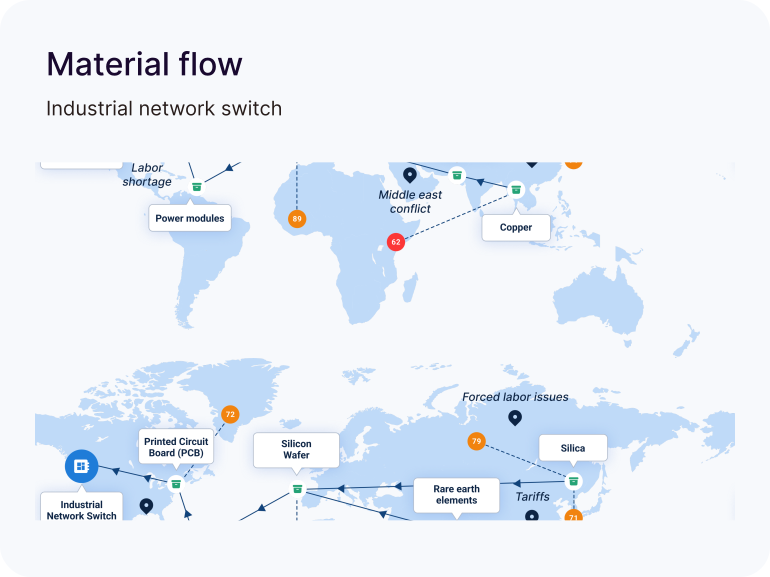
The missing link was material breakdown tied to sub-tier mapping — the ability to decompose products into parts, components, and raw materials, trace those dependencies to specific suppliers and sites, and link the whole structure back to revenue at risk.
Belden needed a solution that could provide sub-tier mapping across sites, materials, and parts that are typically hidden across supplier tiers and reveal their interdependencies: which suppliers support which parts, which sites are tied to which components, which materials flow into which products, and where exposure sits when disruption occurs. With that line of sight, Belden’s procurement could prioritize spend, sourcing, and mitigation by actual business impact rather than best guesses.
Belden’s vision:
Build a resilient, intelligence-driven supply chain
- Increase visibility: Gain end-to-end insight across suppliers, parts, and sub-tier dependencies
- Create flexibility: Adapt quickly to disruptions with alternative sourcing and dynamic decision-making
- Enable collaboration: Connect internal teams and suppliers to align on risk, response and execution
- Improve control: Standardize process and centralize data to drive faster, more confident decisions
Belden’s resilience vision: visibility, flexibility, collaboration, and control.
“
Based on the revenue exposure, we were able to convince the operations team to build safety stock. Inventory turns are important—but the data helped us show the business risk.”
Shakeel Ahmed
Procurement Excellence Lead, Belden
When risk became real
The Nexperia disruption made the case for sub-tier visibility impossible to ignore. In 2022, a government-mandated divestment involving semiconductor manufacturer Nexperia’s UK operations rippled uncertainty across component ecosystems. For Belden, this was not a news item to monitor—it was a series of urgent questions procurement had to answer fast: which products use these components, which sub-tier suppliers and sites are connected, which Tier-1 suppliers have a contingency plan, and how much revenue is on the line.
Emerging DRAM shortages followed the same pattern. Belden saw constraints forming early, but the signal needed deeper evaluation to translate into action. Resilinc-powered mapping and material breakdown connected the shortage to specific products, component dependencies, supplier relationships, single-source exposure, and revenue impact—giving Shakeel the evidence to engage operations on safety stock and push commodity managers toward dual-source alternatives.
The solution
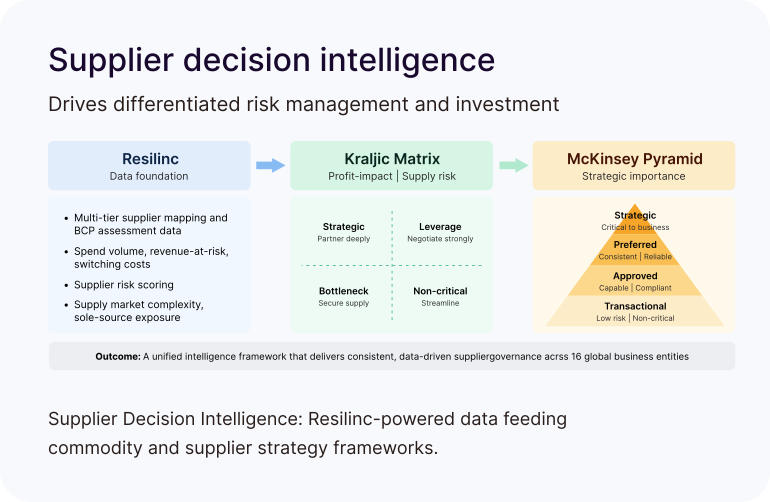
Belden chose Resilinc because mapping a supply chain of this complexity required more than a supplier directory or a static risk dashboard. It required a way to autonomously discover supplier, site, part, component, and material relationships across tiers—then validate the critical connections that matter most to the business. With Resilinc, Belden gained a single agentic platform to map sub-tier suppliers, break down material dependencies, monitor events, assess supplier risk, and coordinate response across the network.
That platform powers Belden’s Supplier Decision Intelligence model. Resilinc’s validated mapping, material breakdown, revenue exposure, and risk-resiliency scores place every supplier and commodity in context. Spend, revenue at risk, resiliency, sourcing concentration, supplier-site relationships, and material dependencies roll up into one view that commodity managers can actually act on.
The power is in the connected supply chain map. A supplier is not viewed only as a spend line. It can be understood in relation to the sites it operates, the parts it supports, the components and materials behind those parts, the products that depend on them, and the revenue exposure tied to each relationship.
From that mapped view, suppliers fall into clear tiers, Strategic, Preferred, Approved, or Transactional, and commodities sort into a Kraljic-style matrix of strategic, bottleneck, leverage, or standard. Decisions stop being argued from intuition. Commodity managers can show why a category is strategic for Belden, whether the picture changes by region, which dependencies are driving risk, and which mitigation, sourcing, or partnership move should follow.
What Resilinc maps:
- Supplier relationships across Tier-1 and sub-tier networks
- Site-level dependencies tied to regions and disruption exposure
- Part, component, and material linkages behind finished products
- Revenue exposure connected to suppliers, sites, parts, and materials
- Validated supplier responses that confirm critical dependencies
“
We take revenue exposure, spend, and the risk resiliency score from Resilinc, then use that to build a composite score. That becomes the basis for strategy development and future risk mitigation planning.”Shakeel Ahmed
Procurement Excellence Lead, Belden
The result
The biggest shift is in decision quality. With Resilinc, Belden can analyze hundreds of suppliers through a consistent, mapped lens: spend, revenue exposure, material dependency, criticality, risk, resiliency, supplier-site relationships, and single-source exposure, instead of evaluating each supplier in isolation. Category managers can now classify long-tail and lower-tier suppliers with confidence, surface hidden revenue exposure, and decide where to consolidate, mitigate, replace, or invest in a deeper partnership.
Commodity strategy is becoming sharper, too. A category that looks like a global bottleneck can turn out to be strategic in a single region; that distinction changes everything about how it should be sourced. By layering revenue exposure, spend, weighted risk, supplier mapping, and material dependencies, Belden can build strategy by commodity, region, supplier site, and dependency rather than forcing a one-size-fits-all global play.
Material breakdown adds another layer of precision. Belden can look beneath the supplier name to understand which parts, components, or raw materials are creating exposure, which supplier sites are connected to them, and whether alternate sources exist. That makes resilience planning more actionable because mitigation can be targeted to the exact dependency creating revenue risk.
Sourcing resilience itself is now measurable. Belden can see single-source versus multi-source exposure, isolate critical single-source parts, and rank improvements by revenue impact because the underlying supplier, part, and material relationships are mapped. That visibility feeds Shakeel’s design-for-sourcing vision, bringing supplier optionality into the conversation early, before products get engineered into a single-source corner.
Day-to-day response sharpened, too. EventWatchAI alerts gave Belden an earlier read on disruptions, while Resilinc’s mapped supplier-site and material relationships helped teams understand which sites, suppliers, parts, and revenue streams could be affected. That visibility gave Belden enough time to contact suppliers and site operators, accelerate material deliveries, and take proactive action before landfall.
400+
suppliers analyzed for classification and rationalization
99%
faster time to awareness 40 hours → 15 minutes
75–80%
less manual effort 4–5 FTEs → ~1 FTE
Resilinc’s Impact
Resilinc helped Belden strategically move from scattered supplier-risk dashboards to a structured, enterprise-wide procurement resilience model. Across 16 business entities, roughly 1,700 Tier-1 suppliers, and over $1B in annual spend, supplier mapping, supplier-validated site intelligence, material breakdown, risk intelligence, and revenue exposure now live in a single operating view.
For Shakeel and the Belden procurement team, the win is not only faster response. It is the ability to make better supplier and commodity decisions from region to region before disruption becomes business impact; knowing where risk is concentrated, which sites and dependencies matter most, which suppliers to elevate, which to rationalize out of the long tail, and where sourcing resilience still needs to be engineered in.
The longer-term shift is upstream. Resilience is moving out of procurement’s risk register and into how procurement, operations, and design teams think: local-to-local sourcing, supplier relationships, mapped material dependencies, and design-for-sourcing principles that prevent single-source dependency from being baked in at the drawing board.
Impact at a glance:
- Scale: 16 entities | ~1,700 Tier-1 suppliers | $1B+ spend
- Analysis: 40 hours → 15 minutes
- Manual effort: 4–5 FTEs → ~1 FTE
- Strategic shift: From visibility to mapped, revenueaware sourcing action
Target plan of attack
Current condition: Due to the absence of resilience pillars such as visibility, flexibility, collaboration, and control, organizations have limited time to respond when disruptions occur within the supply chain.
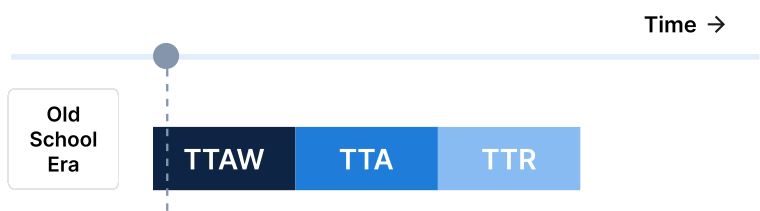
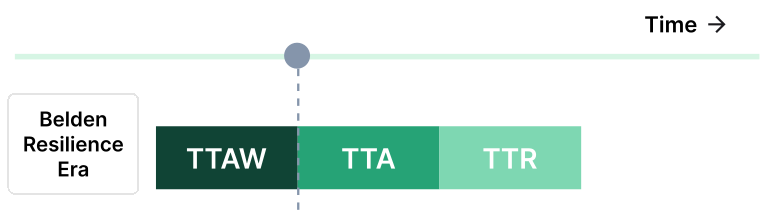
Target Plan of Attack: Build resilience through four supply chain pillars and AI-driven risk intelligence, reducing awareness, action, and recovery times while extending overall time-to-survive.
Key definition:
- TTAW (Time to Awareness): Time required to identify a disruption, ideally before it impacts operations.
- TTA (Time to Action): Time required to initiate mitigation and response activities.
- TTR (Time to Recovery): Time required to restore operations to normal performance.
- TTS (Time to Survive): Maximum duration the supply chain can continue meeting demand after a disruption.
Belden’s target plan: Use mapped supplier, site, part, and material intelligence to compress time to awareness, action, and recovery — extending time to survive.
“
If there is any event coming up, the first question senior leadership asks is: what is the revenue at risk? Now we can answer that question in a couple of seconds.”Shakeel Ahmed
Procurement Excellence Lead, Belden
See agentic AI in action
See how Resilinc turns complex supplier networks into revenue-aware sourcing intelligence, helping teams uncover hidden dependencies, prioritize risk by business impact, and act with greater confidence.