
- Executive Whitepaper
From supply chain visibility to business value
How Databricks powers Resilinc’s product-to-material flow intelligence

Modern supply chains are fragmented. Product and material data, supplier relationships, shipment and trade records, risk and compliance intelligence, and financial exposure often live in different systems, owned by different teams. Each function may hold useful information, but while those signals remain disconnected, executives cannot quickly answer the questions that matter: which products are exposed to rare earth minerals or other constrained materials, which suppliers, sites, or countries create the exposure, which external events could amplify it, which customer commitments are at risk, what the revenue impact is, and which mitigation to prioritize first.
Resilinc addresses this through an operating model built around SENSE, RECOMMEND, and ACT. Resilience cannot be solved by a repository alone; customer-owned product, BOM, purchase, supplier, and logistics data must be triangulated with Tier 1 relationships and sub-tier evidence where customers often lack direct influence.
Resilinc helps customers SENSE the extended supply chain by transforming those signals into a connected, product-aware, material-flow network view. It helps them RECOMMEND the right decisions by connecting risk, compliance, labor, tariff, sourcing, and logistics pressures to products, components, materials, suppliers, sites, customers, revenue, and sourcing options. It helps them ACT through coordinated response workflows, supplier outreach, compliance assessments, dashboards, and AI agents.
Resilinc brings the domain intelligence, data integrations, mapping methodology, risk and compliance content, validation workflows, and customer-facing applications. Databricks provides the scalable lakehouse architecture, compute, governance, lineage, and AI/analytics foundation that allows Resilinc to stitch these signals together, process them at enterprise scale, and serve them as governed, decision-ready intelligence.
The result is more than a better supplier map. It is a reusable product-to-material intelligence layer that connects products, materials, suppliers, sites, shipments, geographies, risk events, compliance signals, confidence scores, and business impact — the shared foundation that moves customers from fragmented visibility to executive decision-making.
Sense
Recommend
Act
Powered by Databricks Lakehouse • Delta Lake • Unity Catalog • SQL • ML Flow • Governed at Enterprise Scale
“
Resilinc gives us the visibility to truly see our supply chain and the ability to quickly find alternate suppliers which has helped us avoid delays and disruptions.”

Marty Wojtowicz
Director of Supplier Quality and Development and Supplier Business Continuity, Yazaki
~92%
Material-breakdown accuracy, validated against bills of materials
40+
Global disruption categories tracked continuously
1 month → 1 hour+
Illustrative compression from risk signal to action with the network + AI agents
Risk lives beyond the line of sight
Supply chain risk is now a Board-level issue. Executives are accountable for the full spectrum of exposure: supplier continuity, geopolitical change, cyber risk, extreme weather, logistics constraints, supplier financial distress, labor disruption, regulatory enforcement, trade policy, tariffs, forced-labor compliance, EUDR obligations, supplier concentration, and revenue at risk.
Resilinc customers span industries where finished products depend on components, sub-components, material composition, qualified suppliers, regulated materials, precision manufacturing, and global logistics. Across auto and industrial manufacturing, high-tech electronics and semiconductors, aerospace and defense, and life sciences and health care, leaders face a common challenge: they may know their direct suppliers well, but still lack a clear view into the Tier 2, Tier 3, Tier 4, or deeper suppliers, sites, and material flows that determine whether a product can actually be produced, shipped, certified, or delivered.
For example, mapping a smart thermostat can uncover a multi-tier network spanning semiconductors, display assemblies, sensors, plastic housing, and upstream materials such as silicon, copper, and polymer resins. A tariff action on semiconductors or a disruption to polymer feedstock can cascade through tiers before surfacing as a production issue. Material-level visibility ties those risks to the affected components and products before a disruption occurs.
The issue is not simply whether data exists, or whether it can be centralized in a lakehouse. Many companies already have valuable Tier 1 supplier information, bills of materials, purchase orders, logistics records, supplier performance data, and compliance documentation. But known enterprise data alone rarely reveals the full product-to-site-to-sub-tier path. The power comes from connecting those known inputs with derived and validated intelligence: autonomous mapping beyond Tier 1, material breakdown that links components and materials to relevant supplier paths, and validation workflows that strengthen confidence where decisions require defensibility.
When these risks are not managed with connected visibility, the impact can become material quickly — from millions to tens of millions of dollars in recurring cost, and in high revenue or highly regulated product lines, potentially hundreds of millions of dollars in delayed shipments, product holds, margin loss, lost revenue, or customer exposure.
Why N-tier visibility is now a Board level priority
Current tools were built for transactions, periodic validation, and functional workflows — not continuous N-tier intelligence. Supplier surveys and ERP data provide a useful Tier 1 foundation, but they rarely reveal the upstream supplier paths, site level dependencies, material relationships, and country-of origin exposure that determine whether a product can be made, shipped, certified, or delivered. The gap is not simply the absence of data. It is the absence of a connected, product-aware network that turns fragmented signals into business context. Without that network, risk alerts remain noisy, impact analysis becomes manual, compliance reviews become reactive, and executive decisions arrive too late. And delay in acting can mean millions in revenue at risk.
| Challenge | Common approach today | Limitation |
|---|---|---|
| Multi-tier visibility | Supplier surveys, ERP data | Incomplete beyond Tier 1 |
| Risk and event detection | News, alerts, manual monitoring | Late, noisy, not contextual |
| Business impact analysis | Spreadsheets, manual mapping | Slow and hard to scale |
| Supplier coordination | Email, calls | Fragmented and inconsistent |
| Compliance and trade exposure | Periodic audits, manual reviews | Not continuous or proactive |
Resilinc’s answer is an intelligent supply chain network view that becomes the platform for agents, business processes, analytics, and workflows that turn fragmented data into business context and faster decisions.
Sense
Build and continuously enrich the supply chain network
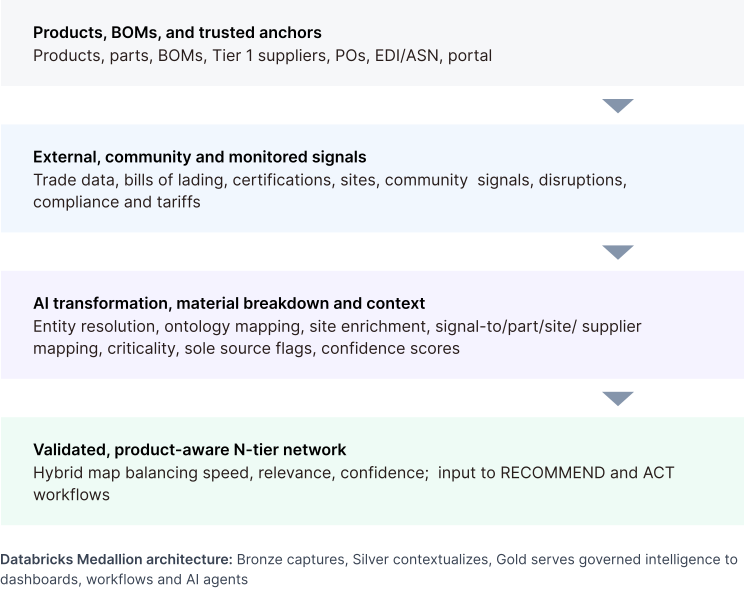
The SENSE layer begins with the products and bills of materials that define what must be built, then grounds the network in trusted business anchors: product and part descriptions, Tier 1 suppliers, customer-provided supplier relationships, validated supplier data, purchase orders, EDI and ASN data, and Resilinc portal data. These inputs anchor the network in the customer’s actual supply chain.
Resilinc then expands the view using external and community based evidence, including global trade data, shipment records, bills of lading, third-party curated datasets, public and open-source data, compliance data, product certification data, site extraction, and community map signals. Resilinc continuously contextualizes those signals to the customer’s products, parts, sites, suppliers, critical parts, sole-source suppliers, and other dependencies that determine what matters. These sources are transformed into candidate relationships that can be normalized, scored, filtered, and validated.
AI-enabled transformation turns raw evidence into usable network structure and customer-specific context. Entity resolution normalizes supplier identity. Predictive field inference helps fill gaps. Schema alignment and ontology mapping create consistency across sources. Site enrichment connects suppliers to physical locations. Confidence scoring distinguishes high-confidence relationships from relationships that require targeted validation.
The differentiator is product relevance. Resilinc does not stop at supplier-to-supplier connectivity. Material breakdown uses AI and large language model techniques to deconstruct finished products into likely constituent parts, components, raw materials, and HS-code relationships. A user can begin with a part description, a single HS code, or multiple HS codes, and Resilinc identifies the relevant supply chain paths for the product or material in scope. Bills of materials are used to validate and improve the model, with current material-breakdown accuracy of approximately 92%.
Validated mapping then strengthens the network. Supplier confirmed data, customer-provided data, and Resilinc portal data combine with autonomous discovery to create a hybrid map that balances speed, relevance, and confidence. Customers gain credible upstream visibility without being constrained by exhaustive supplier surveys as the starting point. This enriched SENSE layer becomes the contextual input to RECOMMEND, so monitored signals can be tied to the exact products, components, materials, sites, and suppliers that drive business impact.
The Sense motion
How Resilinc turns products, BOMs, monitored signals, and material evidence into governed customer context
“
Understanding the risks and vulnerabilities in the sub-tier supply chain is key for proactive supply chain risk management and strengthening resilience for handling disruptions. Resilinc’s evolution toward an agentic system provides customers with the opportunity to understand their sub-tier risk in real time and respond before any disruption affects the direct suppliers. Going forward, we are keen at Hitachi Energy to explore Resilinc’s agentic system capabilities to further strengthen our supply chain resilience.”
Shanshan Guo
Head Resilience and Risk Management SCM, Hitachi
Recommend
Translate network intelligence into prioritized decisions
RECOMMEND is where the network becomes decision intelligence. A risk, compliance, tariff, sourcing, or logistics signal becomes valuable at the executive level only when it can be connected to the supplier, site, product, material, customer, revenue stream, compliance obligation, or sourcing alternative it affects. Resilinc uses the network to translate signals into prioritized recommendations: which suppliers require outreach, which products are exposed, which customer commitments may be affected, which sub-tier sites create concentration risk, which alternate suppliers should be evaluated, and which compliance paths require evidence or validation.
For example, if a tariff signal touches semiconductors used in a smart thermostat, RECOMMEND can identify the affected component family, exposed suppliers and sites, likely customer or revenue exposure, and the alternate suppliers or sourcing paths that should be evaluated first.
Act
Orchestrate response and mitigation workflows
ACT is where recommendations become operational. For the same
smart thermostat scenario, the recommended path can become
supplier outreach, sourcing evaluation, compliance evidence requests,
customer impact review, and WarRoom mitigation tracking.
Resilinc turns prioritized insights into coordinated response rooms, WarRoom
impact analysis, supplier outreach, mitigation tracking, alternate sourcing,
RFIs, compliance assessments, audit evidence workflows, executive
reporting, dashboards, and agentic workflows. Resilinc’s current agent areas
— Disruption, Tariffs, Forced Labor Compliance, and EUDR — operate on
top of the same governed network view rather than as isolated tools.
“
For a manufacturer operating at this scale, tariff resilience depends on replacing fragmented, manual tracking with connected supplier visibility and faster decision support.”
Matt Duffy
Chief Procurement Officer, Honeywell
| Value lens | How the network creates business value |
|---|---|
| Revenue protection | Trace risk from a supplier, site, material, region, trade route, compliance issue, or event to the affected product, customer, order, or revenue stream — turning a signal into revenue-at-risk insight. |
| Response orchestration | In coordinated response and WarRoom workflows, identify impacted suppliers and sites, understand product and business-unit dependency, and drive mitigation, alternate sourcing, supplier outreach, and customer communication. |
| Concentration and sourcing | Classify suppliers by network criticality, not just spend — exposing single-source dependencies, upstream chokepoints, regional concentration, and investments that reduce the most exposure. |
| Compliance and tariffs | Support forced labor, EUDR, and tariff analysis by connecting products, materials, sub-tier suppliers, HS codes, country of origin, routes, evidence, policy assertions, and duty rates. |
These are high-value examples of what the network enables — not the boundaries of the platform. The larger point is structural: one governed network can answer many executive questions without requiring a new data model, dashboard, or manual analysis cycle each time.
“
Resilinc started giving us the warning signs over four years ago… that insight allowed us to make decisions early, avoid disruption, and deliver on our commitments.”
Shauna Gamble
Chief Procurement Officer, Bombardier
How Databricks powers Resilinc’s product-to material network view
Resilinc brings together the relevant customer information, supplier intelligence, trade and shipment data, risk and compliance content, community intelligence, compliance signals, and proprietary supply chain intelligence. Databricks provides the scalable lakehouse architecture, compute, governance, lineage, and AI/analytics capabilities that allow Resilinc to ingest, normalize, govern, analyze, and connect those data elements as a unified intelligence layer.
Databricks’ Medallion Architecture provides the design pattern for transforming raw supply chain evidence into trusted intelligence. Think of it as a three-stage refinery where each layer builds on the one before it: Bronze captures raw and semi-raw data; Silver cleans, resolves, and enriches that data into something consistent and reliable; and Gold serves the curated, business-ready intelligence that powers analytics, dashboards, automated workflows, and AI agents.
The result is a clear and auditable path from raw signal to confident decision, so every insight can be traced back to the evidence behind it.
The Databricks Lakehouse Platform, Apache Spark, Delta Lake, Unity Catalog, Databricks SQL, and MLflow support the scalable graph processing, governance, lineage tracking, access control, analytical reuse, and AI/ML lifecycle capabilities required to operate this network at enterprise scale. Delta Lake supports reliable, versioned pipelines; Unity Catalog provides governed access, lineage, and policy control; Databricks SQL serves curated intelligence to dashboards and applications; and MLflow supports repeatable model development and monitoring for entity resolution, field inference, material breakdown, scoring, and agent workflows.
| Layer | Role in Resilience SENSE → RECOMMEND → ACT |
|---|---|
| Bronze | Captures raw and semi-raw evidence from supplier data, trade and shipment records, bills of lading, purchase orders, bills of materials, compliance datasets, community intelligence, risk signals, and event feeds. The goal is to preserve source traceability while bringing heterogeneous signals into the lakehouse. |
| Silver | Normalizes, resolves, enriches, and scores the evidence. Supplier identities are reconciled, site relationships are enriched, product-material relationships are inferred and validated, data quality rules are applied, and confidence scores are assigned. This is where fragmented evidence becomes a coherent supply chain network. |
| Gold | Serves curated, business-ready data products for product-specific supply chain graphs, revenue-at-risk analysis, supplier concentration views, tariff exposure, forced-labor and EUDR workflows, dashboards, agents, and executive reporting. |
“
Resilinc shows how deep supply chain expertise and Databricks technology can come together to turn complex, fragmented operational signals into governed intelligence at scale. By combining Resilinc’s domain intelligence with Databricks’ lakehouse architecture, governance, analytics, and AI capabilities, enterprises can move from supply chain visibility to faster, more confident decisions across resilience, compliance, and revenue protection.”
Shiv Trisal
Global Industrials GTM, Databricks
The financial logic of SENSE, RECOMMEND, ACT
- Sensing earlier improves detection, sub-tier understanding, product-site visibility, and compliance awareness.
- Recommending better improves prioritization, recoverability, sourcing decisions, tariff analysis, and revenue-at-risk calculations.
- Acting faster reduces premium freight, manual coordination, recovery time, avoidable delays, audit and detention risk, and customer exposure.
For complex manufacturers, these recurring costs can accumulate into millions or tens of millions of dollars annually. In high-revenue or regulated product lines, unmanaged exposure can rise far higher. The investment case is driven by the fact that the same network improves multiple value levers at once.
Compressing Sense → Recommend → Act
Traditional response
- DAY 1: Signal undetected or uncontextualized
- DAYS 3–20: Manual validation and data gathering
- DAYS 20–29: Impact unclear; alternatives late
- DAY 30: Action begins with higher cost
Resilinc network + AI agents
- MINUTE 1: Risk detected and contextualized (SENSE)
- MINUTE 2: Recommended actions prioritized (RECOMMEND)
- MINUTES 3–5: Human in-the-loop validation
- MINUTES 6–60: Mitigation in motion (ACT)
Executive takeaway: The difference between one month and one hour can become a competitive advantage.
“
Executive takeaway: The difference between one month and one hour can become a competitive advantage.”
Ruben Muñoz Aguilera
Global Risk & Security of Supply Program Manager, Roche
Conclusion
The future of supply chain resilience will not be defined by static supplier lists, periodic surveys, or disconnected dashboards. It will be defined by dynamic, product-aware, material-flow-aware, governed networks that help enterprises SENSE the extended supply chain, RECOMMEND the right action in context, and ACT before risk becomes business impact.
Resilinc brings the supply chain intelligence: autonomous mapping, material breakdown, validated mapping, community intelligence, risk and compliance content, compliance context, workflows, and customer-facing applications. Databricks provides the lakehouse architecture, compute, governance, lineage, and AI/analytics foundation that allows this intelligence to scale.
Together, Resilinc and Databricks enable enterprises to move from fragmented visibility to product-to-material flow intelligence — and from that intelligence to measurable business value.
See agentic AI in action
Supply chain resilience starts with connected intelligence. Schedule a demo to see how Resilinc helps organizations sense risk, recommend the right actions, and act before disruptions become business impact.