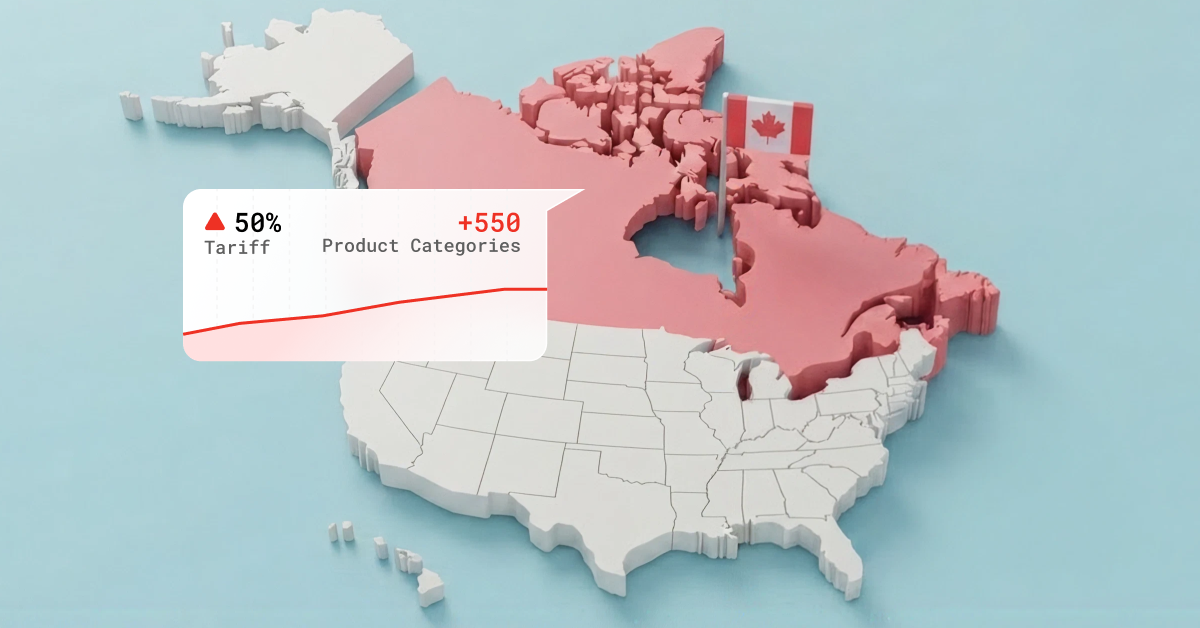
Most of the attention surrounding the latest U.S. tariffs on Canada has focused on motor vehicles, dairy products and alcoholic beverages. The official tariff lists tell a much broader story.
Announced on July 20, 2026, the new 50% tariffs apply to Canadian goods covered by 554 eight-digit Harmonized Tariff Schedule of the United States (HTSUS) classifications, spanning chemicals, industrial materials, packaging, machinery, wood products, paper goods and consumer products. The duties take effect on August 19, 2026, leaving companies with a limited window to determine where new costs may emerge across their supply chains.
For many organizations, the challenge is identifying where those classifications intersect with suppliers, parts, and countries of origin. A company may never import a Canadian automobile, alcoholic beverage or dairy product and still depend on materials or components included in the new tariff lists.
What did the United States announce?
On July 20, 2026, President Donald Trump signed three presidential proclamations imposing an additional 50% ad valorem tariff on selected Canadian imports. The administration said the action responds to discriminatory Canadian trade practices affecting U.S. motor vehicles, alcoholic beverages and dairy products.
The proclamations create three separate tariff lists:
| Tariff Action | HTSUS Classifications | Examples |
| Motor vehicle proclamation | 439 | Chemicals, plastics, machinery, wood, paper, tools, furniture and consumer goods |
| Alcohol proclamation | 63 | Beer, wine, spirits, paper products, wood products and hockey equipment |
| Dairy proclamation | 52 | Milk powders, whey, lactose, casein and protein preparations |
| Total | 554 | Products spanning multiple industrial sectors |
While the proclamations focus on specific trade disputes, the product lists extend well beyond those industries. Together they cover manufacturing inputs, agricultural commodities, construction materials, packaging products, industrial equipment and consumer goods used throughout North American supply chains.
According to the White House, the additional duties generally apply even when covered goods qualify for preferential treatment under the United States-Mexico-Canada Agreement (USMCA). The tariffs are scheduled to take effect at 12:01 a.m. Eastern Time on August 19, 2026, for covered goods entered for consumption or withdrawn from warehouse for consumption.
Why supply chain teams should pay attention
Trade disputes are often discussed through the industries that trigger them. The operational impact is usually much broader. Many organizations will not import Canadian automobiles, alcoholic beverages or dairy products directly. They may, however, purchase components, packaging or raw materials from suppliers that rely on Canadian production. Those costs can move through multiple tiers of the supply chain before becoming visible to the final buyer.
The breadth of the new tariff lists makes exposure difficult to identify through supplier names alone. Procurement teams need to understand which products are covered, where those products originate, and which supplier sites contribute to that exposure.
Do the tariffs apply to USMCA-compliant goods?
Yes. The White House stated that the additional Section 338 duties generally apply to products listed in the annexes even when those goods qualify as originating under the USMCA.
For companies that have relied on the agreement to support duty-free trade across North America, this changes how tariff exposure must be evaluated. Determining whether a product qualifies under USMCA is no longer sufficient. Importers must also determine whether its eight-digit HTSUS classification appears in one of the three tariff annexes. The additional duties may also apply alongside ordinary customs duties and other applicable trade remedies where relevant.
When do the new tariffs take effect?
The additional tariffs are scheduled to take effect on August 19, 2026, providing organizations with a short implementation window.
During that period, supply chain teams should review:
- HTSUS classifications assigned to imported products
- Countries of origin across supplier locations
- Potential landed-cost increases
- Existing supplier contracts and pricing terms
- Alternate sourcing opportunities where available
Companies should also consider indirect exposure. Tariff-related cost increases may emerge through Tier-1 suppliers that purchase affected Canadian materials or components further upstream.
Which Canadian products are affected?
The three tariff annexes cover products used across manufacturing, agriculture, food production and consumer markets. While the complete list contains 554 HTSUS classifications, the products fall into several major groups.
Alcoholic beverages and related products
The alcohol-related proclamation covers far more than alcoholic beverages.
| Category | Examples |
| Beer and wine | Beer, sparkling wine, still wine, vermouth |
| Distilled spirits | Whisky, rum, gin, vodka, tequila, mezcal, brandy and liqueurs |
| Fermented beverages | Cider, sake, rice wine and specialty beverages |
| Other products | Grapefruit essential oil, wood products, paper products and selected hockey equipment |
The inclusion of paper products, wood articles, and sporting goods demonstrates that reviewing only the title of the proclamation is unlikely to identify actual tariff exposure.
Dairy ingredients and food manufacturing inputs
The dairy-related annex focuses primarily on ingredients used in food manufacturing rather than finished retail dairy products.
| Category | Examples |
| Milk products | Powdered milk, concentrated milk, cream preparations |
| Dairy ingredients | Whey, modified whey, lactose and milk constituents |
| Protein products | Casein, caseinates, egg albumin and protein preparations |
| Food manufacturing inputs | Glucose syrup, fructose syrup, bakery mixes and prepared dough |
Many of these products are incorporated into processed foods, nutritional products, pharmaceuticals and industrial applications. Exposure may therefore exist several tiers upstream from the finished product.
Agricultural and natural materials
The motor-vehicle-related proclamation also includes a wide range of agricultural and natural products.
| Category | Examples |
| Agricultural products | Natural honey, hop cones, mint leaves and seaweed |
| Plants and flowers | Flower bulbs, live plants, mushroom spawn, roses and orchids |
| Seeds | Sugar-beet seed, vegetable seed, clover seed and flower seed |
| Natural materials | Feathers, down, natural sponges, bamboo materials and vegetable extracts |
These classifications extend into industries ranging from food manufacturing and landscaping to consumer goods and packaging.
Chemicals and industrial ingredients
Chemical products represent one of the broadest areas of exposure within the new tariff lists. Many serve as intermediate materials used in manufacturing rather than finished goods, making them more difficult to identify through traditional procurement reviews.
| Category | Examples |
| Industrial chemicals | Fatty acids, fatty alcohols, stearic acid, oleic acid and chemical preparations |
| Manufacturing inputs | Modified starches, sugar alcohols, industrial mixtures and processing ingredients |
| Coatings and formulations | Paints, printing inks, lubricating-oil additives and fragrances |
| Personal care ingredients | Essential oils, cosmetics and hair preparations |
For many organizations, these products will not appear on a direct bill of materials. Their impact may first emerge through supplier price increases as manufacturers pass higher import costs downstream.
Plastics and packaging
Packaging materials represent another area where tariff exposure may be less visible than the finished products they support.
| Category | Examples |
| Plastic materials | Polypropylene film, polyester materials, polylactic acid and vinyl flooring |
| Packaging products | Plastic bags, bottles, closures and containers |
| Finished plastic goods | Tableware, office products and household articles |
| Industrial applications | Plastic sheets, films and molded products |
Manufacturers may encounter indirect tariff exposure when Canadian packaging materials are purchased by suppliers and incorporated into finished products delivered downstream.
Wood and paper products
Wood and paper account for a significant portion of the covered HTSUS classifications.
| Category | Examples |
| Wood materials | Sawn wood, plywood, veneered panels, charcoal and fuel wood |
| Finished wood products | Packing cases, frames, barrels, tableware and decorative wood articles |
| Paper materials | Kraft paper, paperboard, greaseproof paper and coated paper |
| Finished paper goods | Cartons, envelopes, notebooks, labels and other paper products |
Organizations that rely on paper packaging, wood pallets or specialized wood products should review whether those materials originate from affected Canadian suppliers.
Textiles and apparel
The tariff lists also include a range of textile materials and finished products.
| Category | Examples |
| Raw materials | Raw cotton, cotton waste, silk waste and wool waste |
| Industrial textiles | Polyester fabrics, synthetic yarns, nonwoven materials and coated textiles |
| Finished goods | Carpets, gloves, footwear and headwear |
| Other textile products | Rope, cordage, wigs and related products |
Industrial users of nonwoven materials, coated fabrics, and technical textiles may experience exposure even when apparel is not part of their business.
Machinery, tools and industrial equipment
The largest proclamation includes numerous products used throughout industrial operations and manufacturing.
| Category | Examples |
| Mechanical equipment | Pumps, compressors, hydraulic turbines and superchargers |
| Manufacturing equipment | Printing machinery, distilling equipment and industrial treatment equipment |
| Material handling | Lifting equipment and handling systems |
| Components and tools | Shafts, gears, transmission parts, wrenches, socket sets, pliers and saw blades |
For manufacturers, the impact may appear in maintenance spending, replacement parts or capital equipment rather than direct production materials.
Consumer products
The tariff action also extends into finished consumer goods.
| Category | Examples |
| Household products | Furniture, mattresses, bedding and lighting |
| Personal goods | Handbags, luggage, leather gloves and belts |
| Recreation | Toys, games, fishing equipment and swimming pools |
| Sporting goods | Hockey equipment and other sports equipment |
| Cultural goods | Artwork, collectibles and antiques |
Although these products represent a smaller share of industrial purchasing, they demonstrate the breadth of the tariff action beyond the sectors highlighted in public announcements.
Which products are excluded?
The White House identified several categories that remain outside the new tariff action, including:
- Energy products
- Potash
- Critical minerals
- Fish products
The additional duties also do not apply to articles already subject to Section 232 duties. Qualifying goods covered by the WTO Agreement on Trade in Civil Aircraft are likewise exempt, except for unmanned aircraft.
Importers should verify the applicable HTSUS classification before assuming an exclusion applies. Eligibility depends on the specific customs classification and treatment of an individual product rather than the broader industry category.
What should supply chain teams do before August 19?
The period before implementation provides organizations with an opportunity to understand where tariff exposure exists and prioritize mitigation efforts before the duties take effect.
The first step is identifying which imported products correspond to the 554 HTSUS classifications included in the three proclamations. That assessment should extend beyond direct Canadian suppliers to include supplier sites, countries of origin and materials incorporated further upstream.
Priority activities include:
- Confirming HTSUS classifications assigned to imported products
- Reviewing supplier-site and country-of-origin data
- Estimating landed-cost increases
- Identifying parts with concentrated sourcing
- Evaluating alternate supplier locations where available
- Reviewing contracts for tariff responsibility and pricing provisions
Organizations should also prioritize exposure based on business impact rather than simply counting affected products. A specialized material with limited sourcing options may present greater operational risk than a higher-volume product with readily available alternatives.
Companies considering alternate sourcing should evaluate supplier capacity, qualification requirements, lead times, and total landed cost before making sourcing decisions.
From tariff announcement to supply chain action
The July 2026 Canada tariffs illustrate a challenge supply chain teams face with nearly every major trade policy change. Understanding the announcement is only the beginning. The more difficult task is determining which products are affected, where they appear across the supply network and how higher costs may move through suppliers before reaching the business.
For many organizations, that analysis extends well beyond direct imports. A finished component sourced from a domestic supplier may still contain Canadian materials, packaging or intermediate products included in one of the new tariff annexes. Without visibility into supplier sites, countries of origin and part-level relationships, identifying that exposure can be a time-consuming manual process.
Organizations that can quickly connect tariff classifications to suppliers, parts and sourcing locations are better positioned to evaluate financial impact, prioritize mitigation efforts and make sourcing decisions before new duties take effect.
How Resilinc’s Tariff Agent can help evaluate tariff exposure on Canadian goods
Trade policy can change quickly. Understanding how those changes affect an organization’s supply chain often takes much longer. Resilinc’s Tariffs Agent helps organizations evaluate tariff exposure using supplier, part-site and country-of-origin data. The agent identifies alternate supplier locations for parts, compares tariff exposure between the primary country of origin and available alternatives, and highlights opportunities where sourcing from another location may reduce tariff costs.
Recommendations include a prediction score based on the operational similarity between supplier sites, helping procurement teams prioritize alternatives with greater confidence. Opportunities can also be reviewed by part, country and product family, allowing organizations to focus on the areas with the greatest potential business impact. Rather than manually reviewing hundreds of tariff classifications across thousands of purchased parts, procurement teams can focus their efforts on the suppliers and sourcing decisions most likely to influence cost and continuity.
Learn how Resilinc’s Tariffs Agent can help your organization identify tariff exposure, evaluate alternate supplier locations and respond more quickly as global trade policy evolves.