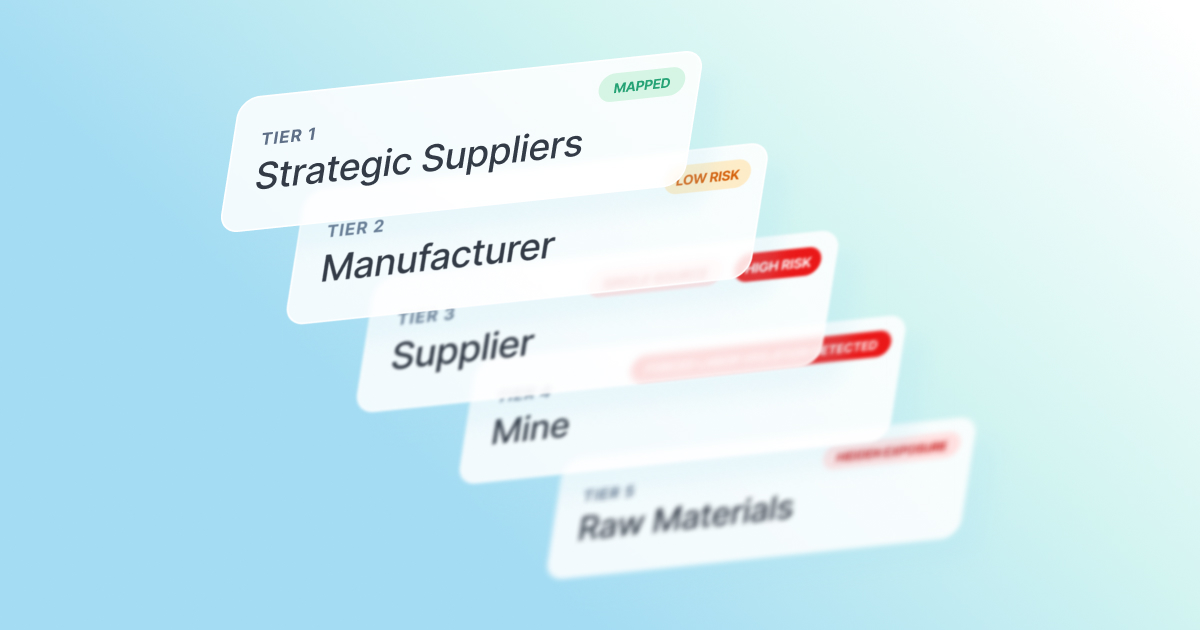

The EU Battery Regulation (2023/1542) is raising the bar for how organizations manage their battery supply chains. Many companies have already taken an important first step: building multi-tier supply chain visibility, sometimes going as deep as ten tiers.
But here is the key question: Is your supply chain map enabling compliance, or just visibility?
Mapping is the foundation, not the finish line
A detailed supply chain map is essential. It tells you who your suppliers are and how materials flow across tiers. With solutions like the Resilinc supply chain graph, organizations can build this visibility using multiple approaches, from autonomous mapping that rapidly scales visibility to validated mapping that delivers highly actionable, decision-ready insights.
However, the regulation does not stop at visibility. It requires companies to act on that information.
To be compliant, organizations need to turn static maps into active, risk-driven systems.
What comes after mapping?
Once you have visibility, the real work begins. At a high level, compliance under the EU Battery Regulation follows a continuous cycle:
Map → Assess Risk → Act → Verify → Report → Repeat
Each step builds on the previous one, turning supply chain visibility into an ongoing, auditable system.
The EU Battery Regulation requires companies to build a structured approach around four key areas:
1. Risk identification and assessment
You need to evaluate risks across your supply chain, especially upstream. This includes:
- Environmental risks
- Human rights concerns
- Governance issues
This is where your supply chain map becomes actionable. Leveraging a dynamic supply chain graph, whether built through autonomous discovery or validated supplier inputs, helps pinpoint where risks are most likely to exist.
2. Supplier engagement
Compliance is not just internal. It extends across your entire supplier network.
You will need to:
- Communicate expectations clearly
- Collect supplier data and declarations
- Ensure requirements are cascaded beyond Tier 1
Engaging suppliers effectively is critical, especially as regulations require deeper-tier accountability. A connected supply chain graph makes it easier to bring suppliers into the process and maintain alignment across tiers.
3. Ongoing monitoring and risk mitigation
Risks are not static, and neither is your supply chain.
Organizations must:
- Continuously monitor suppliers and regions
- Respond to emerging risks
- Track corrective actions when issues arise
This is where many companies struggle. The challenge is moving from one-time assessments to continuous oversight. A living supply chain graph ensures that mapping stays current and usable as conditions change.
4. Reporting and transparency
The regulation requires clear documentation and disclosure of:
- Due diligence processes
- Identified risks
- Actions taken
This information will increasingly feed into requirements like the Battery Passport, making data accuracy and traceability essential. A well-structured supply chain graph supports this by maintaining consistent, traceable records across tiers.
Turning compliance into a scalable system
At Resilinc, we see companies facing a common challenge. They have visibility but lack the infrastructure to operationalize it.
A more integrated approach can help:
- Assessment capabilities allow companies to evaluate supplier risk in a structured, scalable way
- Ongoing monitoring ensures risks are identified as they emerge
- Agentic AI helps detect, prioritize, and drive action on risks across the supply chain
- Built-in reporting simplifies compliance and audit readiness
Equally important, suppliers are part of the process. With accessible tools and no-cost entry points, they can contribute data, respond to assessments, and stay aligned with requirements. This makes compliance more collaborative and achievable.
The shift companies need to make
The EU Battery Regulation is not just about compliance. It is about accountability across the entire value chain.
Companies that succeed will move beyond static visibility and build living, responsive supply chain systems. Because in the end, it is not about how deep your map goes it is about what you do with it.
Take the next step
For organizations looking to operationalize compliance at scale, building the right foundation is critical. Resilinc’s compliance solutions are designed to help companies move beyond visibility and create connected, auditable systems that support ongoing regulatory requirements.
Learn more about how to strengthen your compliance strategy here: https://resilinc.ai/solutions/supply-chain-compliance/