
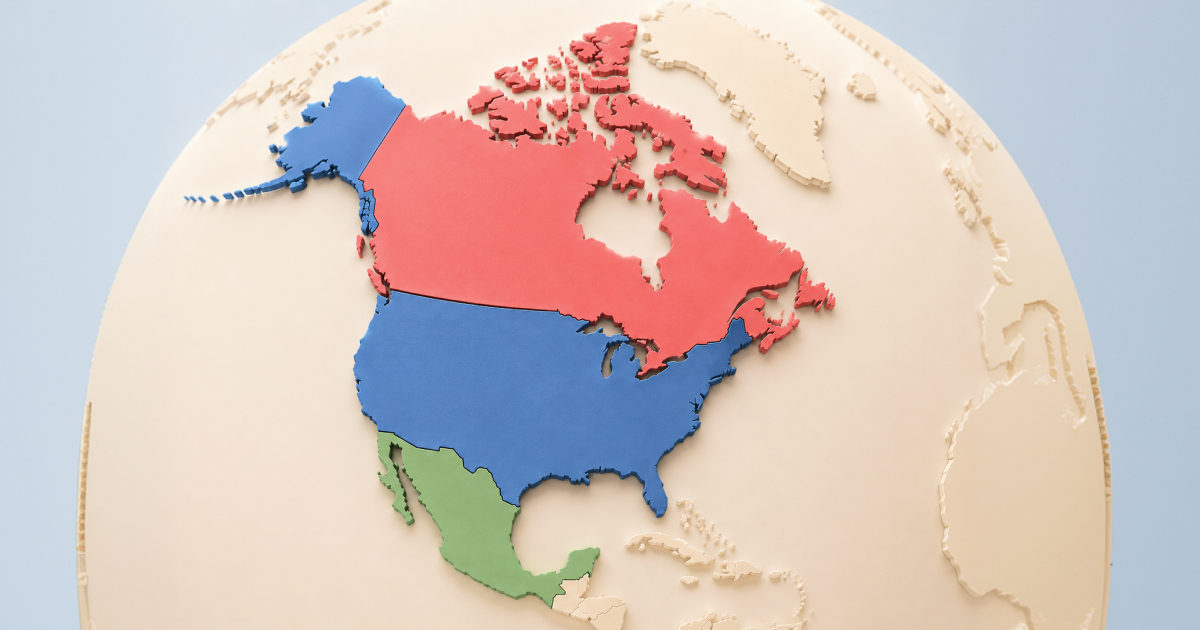

The USMCA review starts July 1. Is your supply chain ready for what comes next?
On July 1, 2026, the United States-Mexico-Canada Agreement enters its first formal review. Roughly $1.5 trillion in annual goods trade — about 5% of U.S. GDP — moves under the rules this agreement sets, putting enormous pressure on companies to accurately document regional content and supplier origins. The good news? Companies don’t have to wait for the outcome. Resilinc’s Tariffs Agent already provides the visibility, traceability, and compliance intelligence needed to prepare for whatever comes next.
What will change in the USMCA review?
As reported by Resilinc’s EventWatchAI, trade policy shifts, tariff actions, and regulatory changes continue to rise across global supply chains. Against that backdrop, three areas are most likely to see meaningful change: autos, advanced technology products, and energy. Across all three, the central concern is the same: whether goods moving through Mexico are genuinely North American, or whether they represent Chinese-origin components assembled close enough to the border to qualify for tariff-free treatment.
Regulators are increasingly focused on distinguishing real nearshoring from what some describe as a “backdoor” for China-linked imports. The likely result is tighter content requirements, stricter origin verification, and greater scrutiny of how regional value is calculated at the component level. To demonstrate compliance, companies may need the ability to trace materials, components, suppliers, and manufacturing activities across multiple tiers—leveraging capabilities such as chain of custody mapping, part-site-activity mapping, material breakdown and material flow analysis to provide date-driven evidence.
Mexico’s rise as the leading U.S. exporter of Advanced Technology Products, a category that includes semiconductors, electronics, and aerospace equipment, makes this scrutiny even more urgent. A large share of that growth reflects legitimate investment. But the pressure to verify it is growing.
The compliance challenge no one is fully prepared for
Here is the operational problem: most companies do not have reliable visibility into the sub-tier origins of the components they source. They know their direct suppliers. They may know some of their Tier 2. Below that, the picture gets murky fast.
Tighter USMCA content rules do not just raise the threshold for qualifying. They raise the evidentiary burden. Companies will need to demonstrate, not just assert, that regional value is met. That requires knowing where parts come from, not just where they ship from.
Autos are the clearest case. A single vehicle can cross North American borders multiple times before it reaches a consumer, with components carrying their own origin history at each crossing. A component may be fabricated at one site, manufactured at another, tested at a third facility, and then move through labeling, packaging, warehousing, and final assembly locations before becoming part of a finished vehicle.
Each activity contributes to the product’s compliance story and may affect how regional value is calculated under USMCA rules. Calculating regional content across that network, particularly when requirements may be changing, is a supply chain intelligence challenge. It requires part-site mapping, material breakdown, and material flow analysis to understand where value is created, how materials move through the supply chain, and whether products truly qualify under evolving USMCA requirements.
Top of Form
Bottom of Form
Where Resilinc’s Tariffs Agent comes in
Resilinc built the Tariffs Agent as an agentic AI solution designed to continuously monitor trade policy, interpret regulatory changes, evaluate supply chain exposure, and recommend actions, helping teams stay ahead of disruption. As USMCA review talks progress, the Tariffs Agent gives procurement and compliance teams the visibility needed to act before rules change, using Resilinc’s Sense-Recommend-Act framework.
Sense – Continuously monitors trade and compliance risk
- Monitors trade policy in real time. Tracks tariff changes, USMCA negotiation developments, and regulatory announcements as they happen, rather than relying on periodic manual review.
- Flags country-of-origin exposure. Identifies suppliers and components with elevated China-linked exposure that could affect USMCA qualification.
- Maps risk to specific business units, products, parts, and suppliers. Connects policy changes directly to the areas of the business most likely to be affected.
- Connects to sub-tier visibility. Paired with Resilinc’s Autonomous Mapping, Material Breakdown, Material Flow Mapping, and Part-Site Mapping capabilities, it traces regional content down to the component level where regulators are increasingly scrutinizing.
Recommend – Turns intelligence into prioritized action
- Recommends next best action. Within Resilinc’s Sense-Recommend-Act framework, the Tariffs Agent evaluates exposure, prioritizes risks, and provides recommended actions so teams know what to address first.
- Identifies mitigation opportunities. Helps teams evaluate alternate suppliers, sourcing options, and compliance strategies before changing regulations create disruption.
Act – Drives supplier engagement and compliance execution
- Collects evidence and validates compliance. Launches supplier outreach to gather country-of-origin data, supporting documentation, and compliance evidence needed to validate USMCA qualification.
- Supports faster response and decision-making. Enables procurement, compliance, and supply chain teams to act on emerging risks with a shared view of impacted suppliers, products, and parts.
The result is a more proactive approach to USMCA compliance, combining agentic AI with human-in-the-loop supplier collaboration to continuously collect, validate, and maintain the evidence needed to demonstrate compliance with confidence.
What to do now, before July 1
The more likely outcome of this review is not a new trade war but a new layer of compliance complexity. Companies that have already mapped their North American supplier networks to the component level will be better positioned to navigate it.
The USMCA review is a known event with a known start date. The supply chains most at risk are the ones that treat it as someone else’s problem until it is not.
Request a demo to see how the Tariffs Agent works.